The Government Contractor's Guide to GTM Content Automation Without Cloud Risk
By Pat McClain | Engineering Operations Leader
10 min read•
AI & Automation
Government contractors build and ship software constantly. They win contracts based on technical capabilities, maintain those capabilities through active development, and compete for renewals and follow-on work against other contractors who are doing the same. The GTM content problem, the gap between what engineering ships and what sales, support, and program management can communicate effectively, is just as acute in the defense and federal sectors as it is anywhere else in the software industry.
The difference is the constraint. Most of the AI tools that commercial software companies use to close that gap are dead on arrival in a govcon environment. They send data to cloud APIs. They process content on shared infrastructure. They require internet connectivity. They don't meet CMMC requirements. They can't handle Controlled Unclassified Information. They were built for commercial enterprises and the entire assumption of cloud-based AI processing is baked into their architecture.
So govcon teams are left where they have always been: doing it manually, falling further behind with every sprint, and watching their commercial competitors use automation that is structurally unavailable to them. That gap is not inevitable. It is a deployment model problem, and it has a solution.
Federal software contractors operate under a set of constraints that commercial software companies don't face. But they share every operational challenge commercial companies have, including the gap between engineering velocity and content production capacity.
A defense contractor building a logistics management platform ships updates constantly. Program managers need to communicate those updates to contracting officers and end users. The capture team needs current technical capabilities documented for the next proposal. Business development needs updated past performance narratives. The transition team needs current technical documentation when a new user community onboards. The help desk needs current KB articles before the user population starts filing tickets about the new features.
None of that content produces itself. In a govcon environment, it typically lands on a small team of technical writers, program managers, or subject matter experts who are already fully committed to the program. The content backlog accumulates the same way it does at any software company. It just accumulates with fewer options for relief.
60%+
Of govcon software updates receive no timely user-facing documentation, per program management surveys
4–6 wks
Typical lag between a software release and updated technical documentation in secure environments
Zero
Major AI content platforms with a compliant on-prem deployment model before OptibitAI
The proposal impact alone is significant. A capture manager preparing a task order response needs accurate, current descriptions of the platform's technical capabilities. If engineering shipped a capability six weeks ago and it isn't in any documented artifact yet, the proposal either omits it or describes it inaccurately from memory. Both outcomes cost points in a technical evaluation. In a competitive procurement, those points are the margin between a win and a loss.
Why Cloud AI Tools Are Dead on Arrival
The commercial AI content automation market has grown rapidly. There are now dozens of tools that help software teams generate release notes, sales enablement content, support documentation, and technical artifacts from their code repositories. Nearly all of them share a fundamental architecture: they process content by sending it to a cloud-based API operated by a third party.
Most AI content platforms are built on cloud API architectures that cannot cross a secure network perimeter. The tools that work for commercial teams are structurally unavailable in air-gapped and CUI environments.
In a govcon context, that architecture creates a list of problems that cannot be engineered around:
✕
Cloud LLM APIs (OpenAI, Anthropic, Google cloud endpoints)
Sending CUI or program-sensitive content to a commercial cloud API violates CMMC Level 2 requirements and most program security plans. The vendor's data handling practices, retention policies, and training data usage are outside the government's control.
✕
SaaS content platforms with cloud storage
Any platform that stores your documents, prompts, or generated artifacts on cloud infrastructure introduces data residency and access control issues. FedRAMP authorization covers a narrow set of platforms and does not extend to most AI content tools.
✕
Browser-based AI tools requiring internet connectivity
Air-gapped networks have no internet access by design. Any tool that requires an outbound connection to function cannot be used on a classified or air-gapped network, regardless of its security certifications.
✕
Multi-tenant SaaS with shared compute infrastructure
Multi-tenant architectures mean your content processing potentially shares infrastructure with other organizations. Even with encryption and access controls, this architecture is incompatible with most govcon security requirements at IL4 and above.
The result is that govcon teams are excluded from an entire category of productivity tooling that their commercial counterparts use daily. The manual content production process that commercial teams have largely automated remains fully manual inside the perimeter.
What a Compliant Deployment Actually Requires
A content automation platform that works in a govcon environment needs to meet a specific set of requirements. These are not negotiable and cannot be compensated for with contractual assurances or vendor attestations. The architecture itself has to be right.
Data Residency
All data stays on your infrastructure
No content, prompts, documents, or generated artifacts should leave the network boundary. Processing must occur on hardware you control, in a location you control, under access policies you define.
LLM Processing
Local model inference, no cloud APIs
The AI model doing the content generation must run on your infrastructure. Calls to external model APIs (OpenAI, Anthropic, Google) send your content to third-party servers. In CUI environments, that transmission is prohibited.
Access Control
Role-based access with enterprise auth
RBAC with clearly defined admin, editor, and viewer roles. Integration with enterprise SSO via SAML/SCIM. Every access event logged and auditable. User permissions manageable without vendor involvement.
Encryption
Data encrypted at rest and in transit
AES-256 encryption for data at rest. TLS for data in transit, including self-signed SSL for air-gapped environments that cannot reach public certificate authorities. No unencrypted data paths.
Deployment Model
Self-contained, no external dependencies
The platform must run without requiring external package repositories, update servers, or licensing checks. Air-gapped deployments cannot make outbound connections for any purpose, including software updates or telemetry.
Audit Trail
Complete activity logging and versioning
Every artifact generated, edited, approved, and published must be logged with user identity, timestamp, and content version. Approval workflows must be documented. This is a compliance requirement for CUI-adjacent content, not a nice-to-have.
How OptibitAI Solves This On-Premises
OptibitAI is one of the only GTM content automation platforms built with a genuine on-premises deployment model. Not a "private cloud" option that still runs on someone else's infrastructure. A fully self-contained deployment that runs on your hardware, inside your network, with no external dependencies.
✓
Docker Compose deployment, single command
The entire platform deploys via Docker Compose onto your existing infrastructure. No proprietary hardware, no cloud dependencies, no vendor-managed components inside your perimeter. Your infrastructure team controls the deployment from day one.
✓
Ollama integration for local LLM inference
Ollama runs open-source language models entirely on your hardware. When OptibitAI is configured to use Ollama, zero content leaves your network for AI processing. Every token generated stays inside your perimeter. This is the architecture that makes air-gapped deployment possible.
✓
AES-256-GCM encryption throughout
All data is encrypted at rest using AES-256-GCM. All transit is encrypted via TLS with support for self-signed certificates in environments that cannot reach public CA infrastructure. Encryption keys are managed within your infrastructure.
✓
RBAC with SAML/SCIM and SSO
Role-based access control with admin, editor, and viewer roles. Enterprise SSO integration via SAML and SCIM supports connection to existing identity providers. User provisioning and deprovisioning through your existing enterprise identity management system.
✓
Self-hosted database, no external storage
OptibitAI ships with a built-in MariaDB instance or connects to your existing MySQL infrastructure. All content, artifacts, version history, and audit logs are stored in your database on your hardware. Nothing persists outside your network boundary.
✓
Complete approval workflows and audit logging
Every artifact goes through a configurable review and approval workflow before publication. All activity, generation events, edits, approvals, and publications, is logged with user identity and timestamp. Audit trails are stored locally and accessible for compliance reviews without vendor involvement.
✓
GitHub Enterprise and Bitbucket Data Center support
OptibitAI connects to on-premises GitHub Enterprise Server and Bitbucket Data Center via custom base URLs. No public GitHub required. Your code repositories stay inside your network and OptibitAI reads from them directly without any data leaving the perimeter.
✓
Custom domain and self-signed SSL support
Full support for custom internal domains and self-signed SSL certificates. Air-gapped environments that cannot reach public certificate authorities can deploy OptibitAI with complete TLS encryption using internally issued certificates.
Already deployed to lab environments: OptibitAI's on-prem deployment model has been deployed and validated in lab environments at a Fortune 100 defense and federal technology organization and others in the govcon space. The deployment scripts, security configurations, and support documentation are built for these environments specifically, not adapted from a commercial SaaS offering.
The Deployment in Practice
Standing up OptibitAI in a secure environment follows a straightforward sequence. The platform is designed to minimize the surface area of the deployment and eliminate external dependencies at every step.
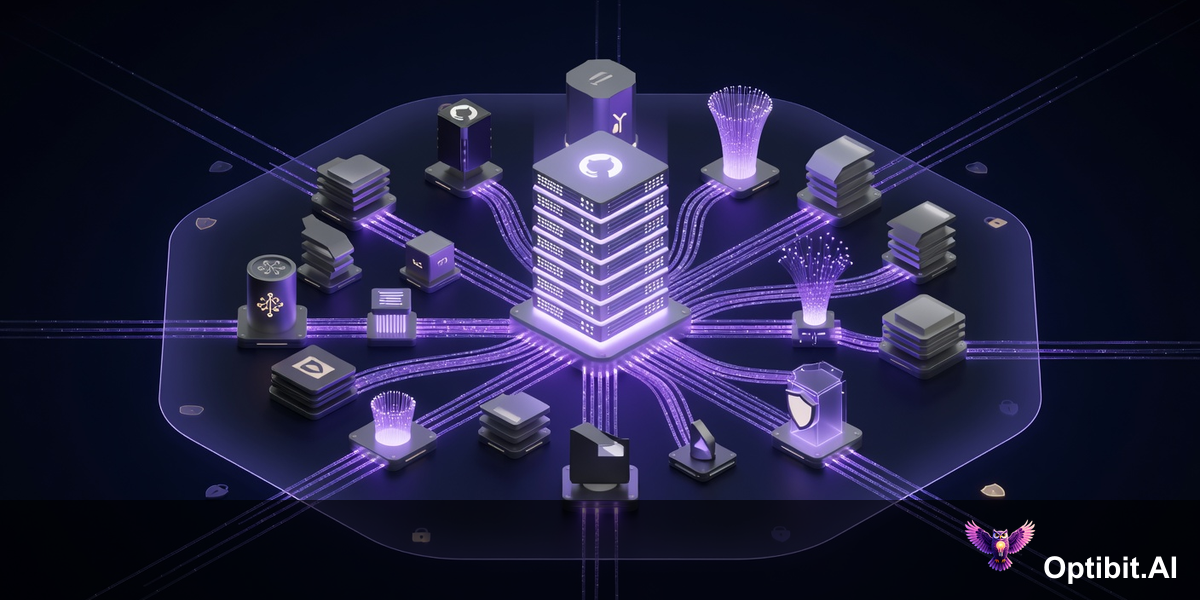
The full OptibitAI deployment: all components within the secure perimeter, local LLM inference via Ollama, on-premises code repository integration, and encrypted local storage. Zero data egress.
1
Infrastructure provisioning
Provision a server or VM meeting the minimum resource requirements within your secure network. OptibitAI runs on standard Linux infrastructure. No specialized hardware, no proprietary operating system requirements.
2
Docker Compose deployment
Deploy the full OptibitAI stack with a single Docker Compose command. All containers, the application server, database, and supporting services, start from the same configuration file. No external package pulls required if images are pre-loaded in your environment.
3
Ollama and local model configuration
Deploy Ollama on the same infrastructure or a dedicated GPU node within your network. Pull the language models you want to use into Ollama's local model store. Configure OptibitAI to route all inference requests to the local Ollama endpoint. From this point, all AI processing is entirely internal.
4
Repository and identity integration
Connect OptibitAI to your on-premises GitHub Enterprise Server or Bitbucket Data Center instance using the internal base URL. Configure your enterprise identity provider via SAML or SCIM for user authentication and provisioning. Define RBAC roles aligned with your program security plan.
5
Corpus population and workflow configuration
Upload your organizational knowledge base into the Corpus: program documentation, past performance narratives, technical capability descriptions, proposal templates, and style guides. Configure approval workflows to match your program's review and authorization requirements. Set auto-approve rules where appropriate for lower-sensitivity artifact types.
6
Production operation
The platform is operational. Teams generate artifacts from releases, proposals, and program events. All content is processed locally, stored locally, and governed by the RBAC and approval workflows you defined. The system requires no external connectivity to function.
What Changes for the GTM Team
The operational impact inside a govcon organization is the same as in any software company, with the added benefit that it is achievable without compromising the security posture.
Program managers who spent hours translating engineering updates into program status communications can generate those communications directly from the code repository in minutes. Technical writers who maintained documentation manually can generate draft artifacts from releases and spend their time reviewing and refining rather than writing from scratch. Capture managers building proposals can pull accurate, current technical capability descriptions from the platform rather than hunting through old deliverables for language that still applies.
The Corpus becomes a program asset. Every document uploaded, past performance write-up, technical description, lessons learned report, and capability narrative, improves every future artifact that touches those topics. The knowledge base grows with the program. New team members come up to speed faster because the institutional knowledge is structured and accessible. Program transitions are smoother because the content infrastructure transfers with the program documentation.
For business development, the impact compounds across the capture lifecycle. A platform capability shipped in sprint 14 can be in a proposal section draft by sprint 15. Competitive differentiators are current because the system that describes them is connected to the repository that produces them. The technical volume of a task order response reflects the actual current state of the platform, not the state it was in when someone last had time to update the capability matrix.
The govcon market has largely been told that AI-powered content automation is a commercial technology that doesn't work inside the perimeter. That assumption is wrong. The architecture that makes it work inside the perimeter exists. The deployment is proven. The security requirements are met by design, not by exception.
If your program teams are still producing GTM and technical content manually while your commercial counterparts automate it, the gap is not a security constraint. It is a vendor selection problem. OptibitAI is the platform that closes it.
Contact us at optibit.ai to discuss a deployment for your program environment.