The Role-Gated Software Era Is Over: Why AI-Native Tools Scale With Work, Not Org Charts
Your company has Salesforce for sales, HubSpot for marketing, Jira for engineering, Zendesk for support, Slack for communication, Notion for documentation, and a dozen other tools, each locked to a specific department.
When a feature ships, information about it is trapped in these silos. Engineering knows it shipped because it's in Jira. Marketing doesn't know until someone manually tells them. Sales doesn't know until someone updates the deck. Support doesn't know until customers start asking about it.
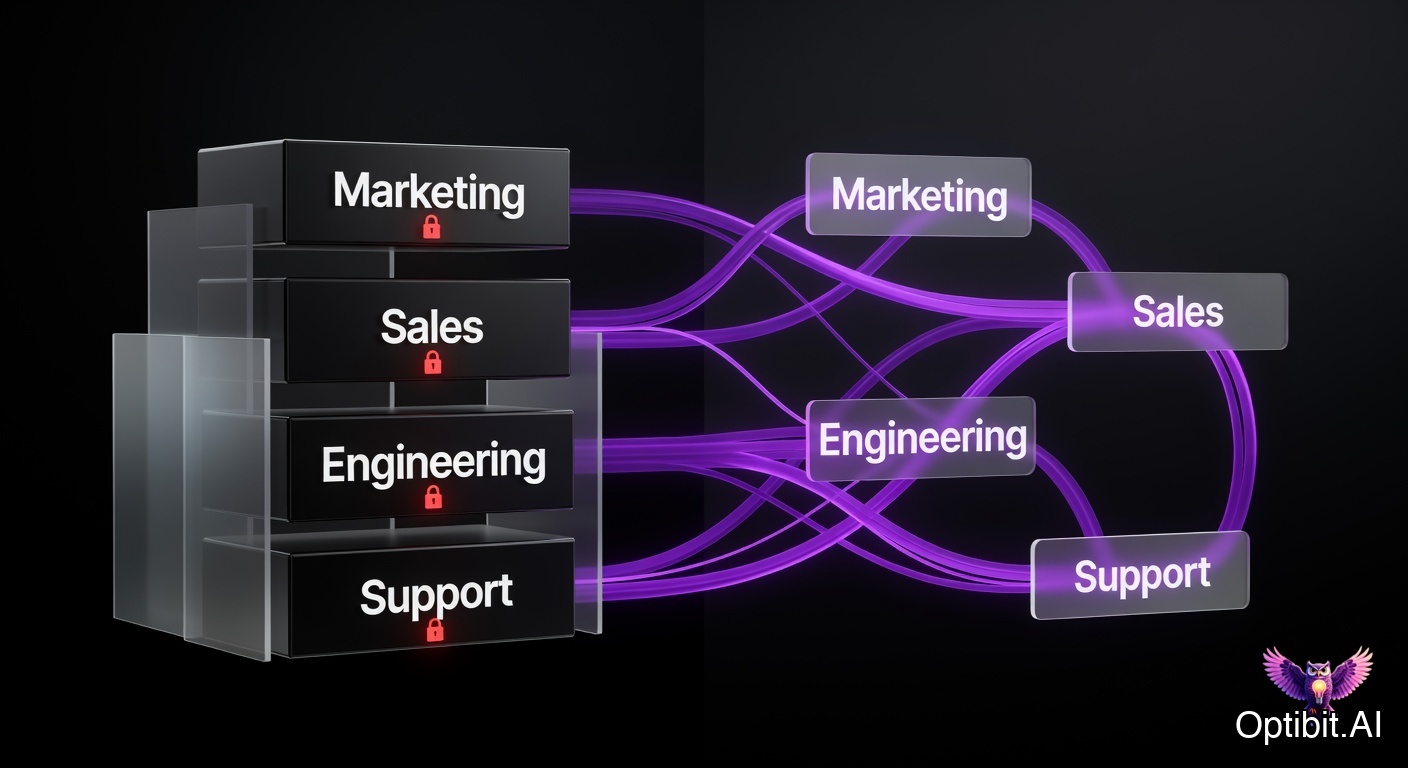
This is the role-gated software era. Tools designed around org charts. Information flow determined by who has access to which platform. Cross-functional work requiring manual stitching across six different systems.
It's dying. And it should.
The Legacy Model: Software Built for Silos
Enterprise software has been designed the same way for 30 years: identify a role, build a tool for that role, sell licenses based on how many people have that role.
Need to manage customer relationships? Buy Salesforce. Number of seats: however many sales reps you have.
Need to track engineering work? Buy Jira. Number of seats: however many engineers you have.
Need to create marketing content? Buy HubSpot. Number of seats: however many marketers you have.
This made sense in a world where work was role-specific and departments operated independently. Marketing did marketing. Sales did sales. Engineering did engineering. They coordinated at quarterly business reviews and annual planning cycles.
But that's not how modern product companies operate.
A product launch in 2026 requires simultaneous coordination across engineering (build it), product (spec it), design (make it usable), marketing (announce it), sales (sell it), support (help customers use it), and customer success (drive adoption).
Work doesn't happen in departmental silos. It happens in cross-functional workflows. But the tools are still designed for silos.
Why Role-Based Tools Create Bottlenecks
Here's what happens when you try to do cross-functional work with role-based tools:
1. Information Gets Trapped in Departmental Systems
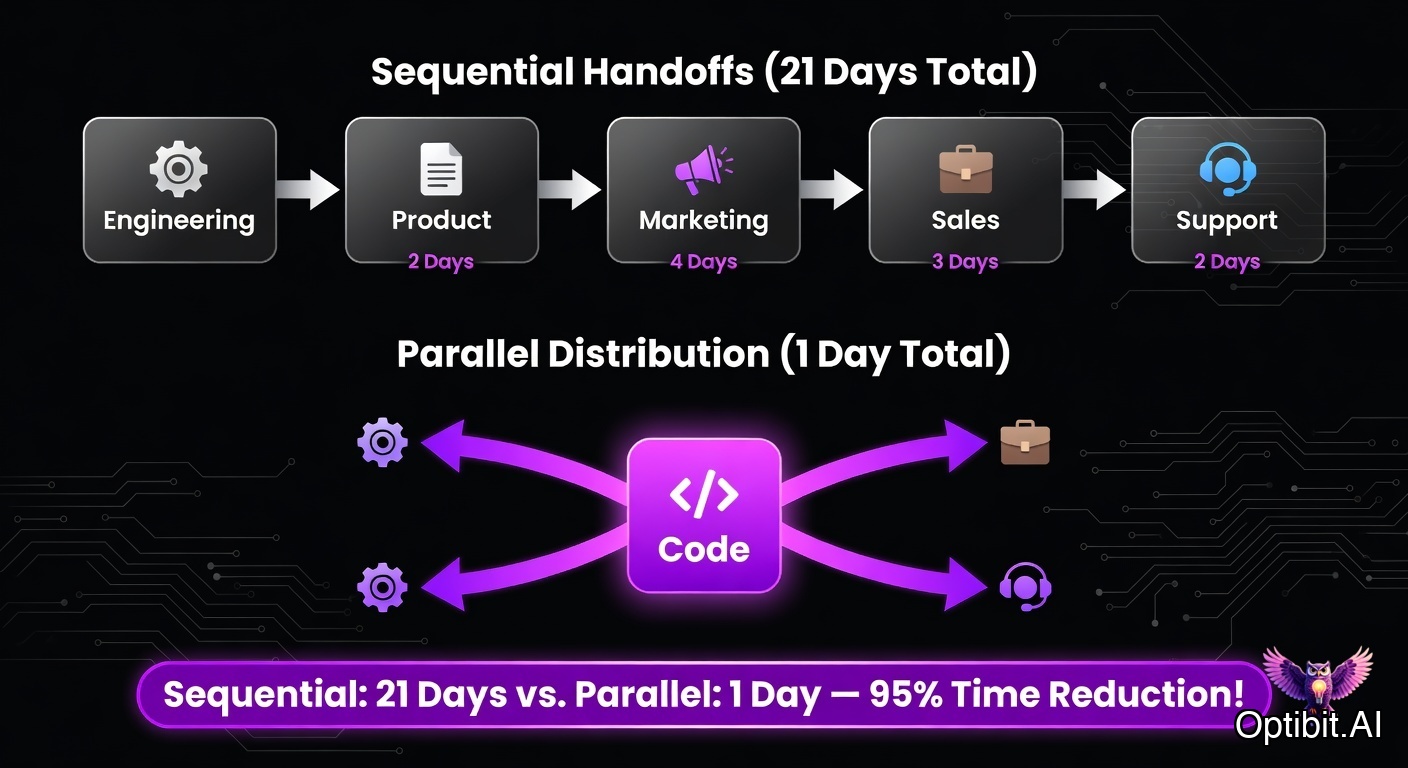
Engineering ships a feature. The information lives in Jira, GitHub, and the engineering team's Slack channel. Marketing needs to know about it to write a blog post. How do they find out?
- Someone manually posts in a shared Slack channel
- There's a weekly sync meeting where engineering summarizes what shipped
- Marketing reads through Jira tickets (if they have access)
- Product acts as a translator between engineering and everyone else
Every one of these is a manual handoff. Every handoff introduces delay and information loss.
2. Access Is Based on Role, Not Need
Your sales engineer needs to understand a technical implementation detail to answer a prospect's question. The information exists in your engineering documentation tool. But sales doesn't have licenses for that tool. They're "not engineers."
So they ask in Slack. Wait for a response. Get a partial answer. Ask a follow-up. Wait again. The prospect gets frustrated with the slow response time. The deal slows down.
The information existed. The person who needed it couldn't access it because the tool was gated by job title.
3. Everyone Maintains Their Own Version of the Truth
Engineering has technical documentation in Confluence. Marketing has customer-facing content in HubSpot. Sales has pitch decks in Google Slides. Support has KB articles in Zendesk. Product has release notes in Productboard.
When a feature changes, all five artifacts need to be updated. Manually. By five different people. Who may or may not remember. Who may or may not have the latest information.
Result: version drift. The engineering docs say one thing. The marketing blog says something slightly different. The sales deck is a month out of date. Support is answering questions based on how the feature worked two releases ago.
Customers notice the inconsistencies. They lose trust.
4. Tool Sprawl Kills Productivity
The average enterprise uses 254 SaaS applications. Knowledge workers switch between tools an average of 10 times per hour.
Each tool has its own login, its own interface, its own way of organizing information. Finding the information you need requires remembering which tool it lives in, navigating to that tool, searching within it, and hoping the information is up to date.
This is cognitive overhead masquerading as "best of breed" tooling.
The AI-Native Shift: Tools That Follow Work
AI-native tools are built on a fundamentally different model. Instead of asking "what does this role need to do?" they ask "what information needs to flow, and to whom?"
Here's the difference:
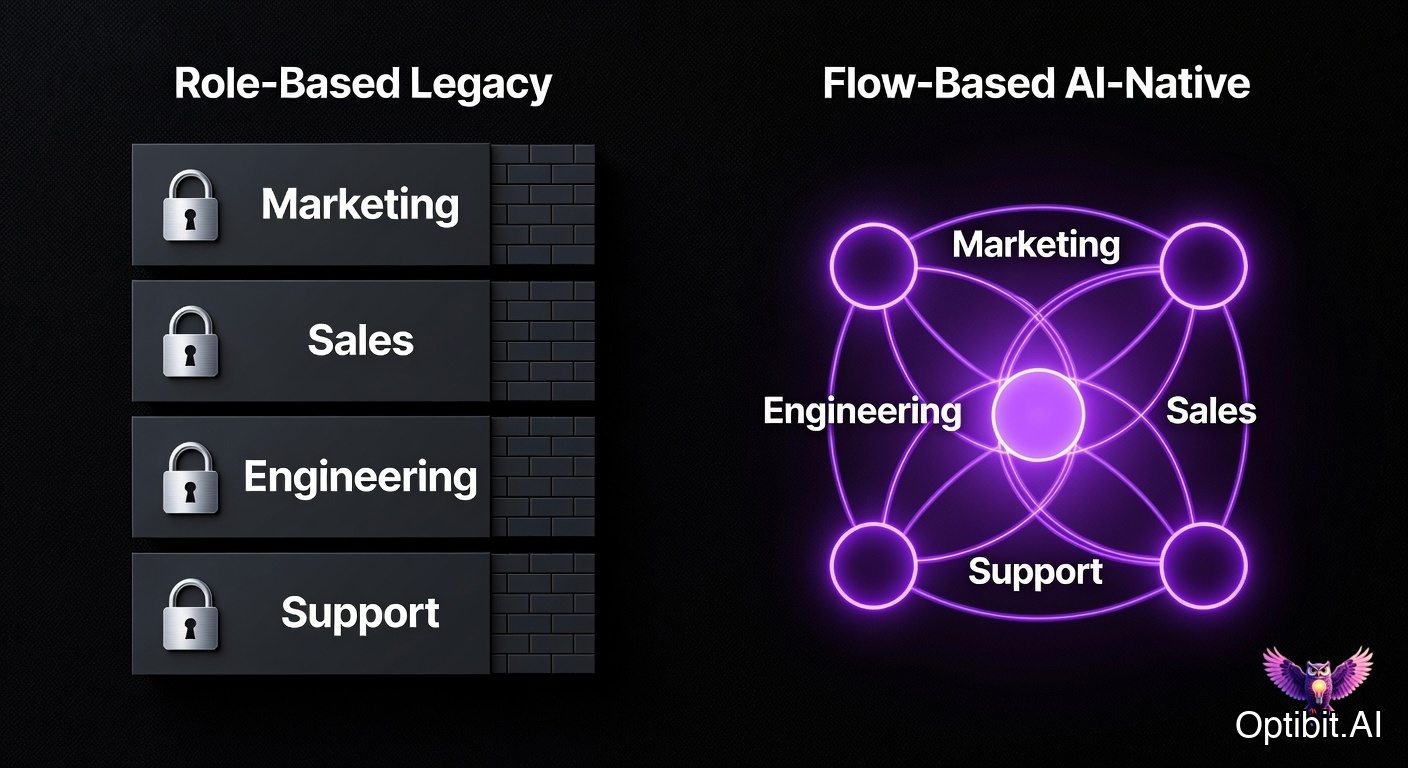
Role-Based Tools (Legacy)
- Built for specific departments
- Access gated by job title
- Information trapped in silos
- Cross-functional work requires manual integration
- Scaling means buying more seats per role
Flow-Based Tools (AI-Native)
- Built around workflows
- Access based on information need
- Information flows to everyone who needs it
- Cross-functional work is automatic
- Scaling means serving more workflows, not more roles
The key insight: AI can generate role-specific outputs from the same source of truth.
Engineering ships a feature. AI reads the code changes. From that single source of truth, it generates:
- Technical documentation for engineers (API changes, migration guides, code examples)
- Marketing blog post for marketers (customer benefits, use cases, positioning)
- Sales talking points for sales (competitive advantages, objection handling, demo scripts)
- KB articles for support (how to use it, troubleshooting steps, known issues)
- Release notes for product (what changed, why it matters, customer impact)
Same information. Five different formats. All generated from the code. All technically accurate. All delivered simultaneously.
No handoffs. No information loss. No version drift. No "did anyone tell marketing we shipped this?"
Why This Changes Everything
When tools scale with work instead of org charts, three things happen:
1. Information Democratization
Anyone can access the information they need, when they need it, in the format that makes sense for their context.
A sales rep can read technical documentation if they're talking to a technical buyer. A support engineer can see marketing positioning if they need to explain value to a confused customer. A product manager can review engineering implementation details without asking developers to explain it.
The artificial boundaries between "this is for engineers" and "this is for marketers" disappear. Information flows based on need, not job title.
2. Organizational Flexibility
Your org chart is not permanent. You reorganize. Teams merge. Roles change. People switch departments.
With role-based tools, every reorg means license shuffling, access reconfiguration, and tool migration. With flow-based tools, the workflows stay the same even when the org chart changes.
The tool doesn't care if marketing and product are one team or two. It cares that when a feature ships, certain information needs to flow to certain people. Whoever those people are, whatever their titles are.
3. Velocity Without Coordination Overhead
The biggest benefit: you can move fast without the coordination tax.
In the role-based world, speed requires more coordination. Engineering ships faster? You need more people to translate what they shipped into marketing content, sales enablement, support documentation. Faster shipping means more coordination meetings, more Slack threads, more "can someone explain what this feature does?"
In the flow-based world, speed doesn't require coordination. The information flows automatically. Engineering ships 10 features a week? Fine. The content generation happens at the same speed. No additional overhead. No coordination bottleneck.
This is how you scale velocity without scaling headcount.
OptibitAI: Flow-Based by Design
We built OptibitAI because we watched companies drown in coordination overhead. Engineering was shipping faster than ever. Marketing, sales, and support were falling further behind.
The problem wasn't people. The problem was that the tools were designed for a world where departments worked independently.
OptibitAI is designed around the workflow, not the org chart:
One Source of Truth: Your Code
We don't ask you to manually input information into another system. We read it from the source: your repositories, your commits, your pull requests.
When you merge code, that's the trigger. Not a calendar date. Not a meeting. Not a Slack reminder. The work itself triggers the content flow.
All Roles, All Outputs
OptibitAI doesn't have "engineering seats" and "marketing seats." It serves everyone:
- Engineering gets technical documentation
- Marketing gets blog posts and announcements
- Sales gets pitch deck updates and talking points
- Support gets KB articles and troubleshooting guides
- Product gets release notes and changelog
- Customer success gets feature summaries and adoption resources
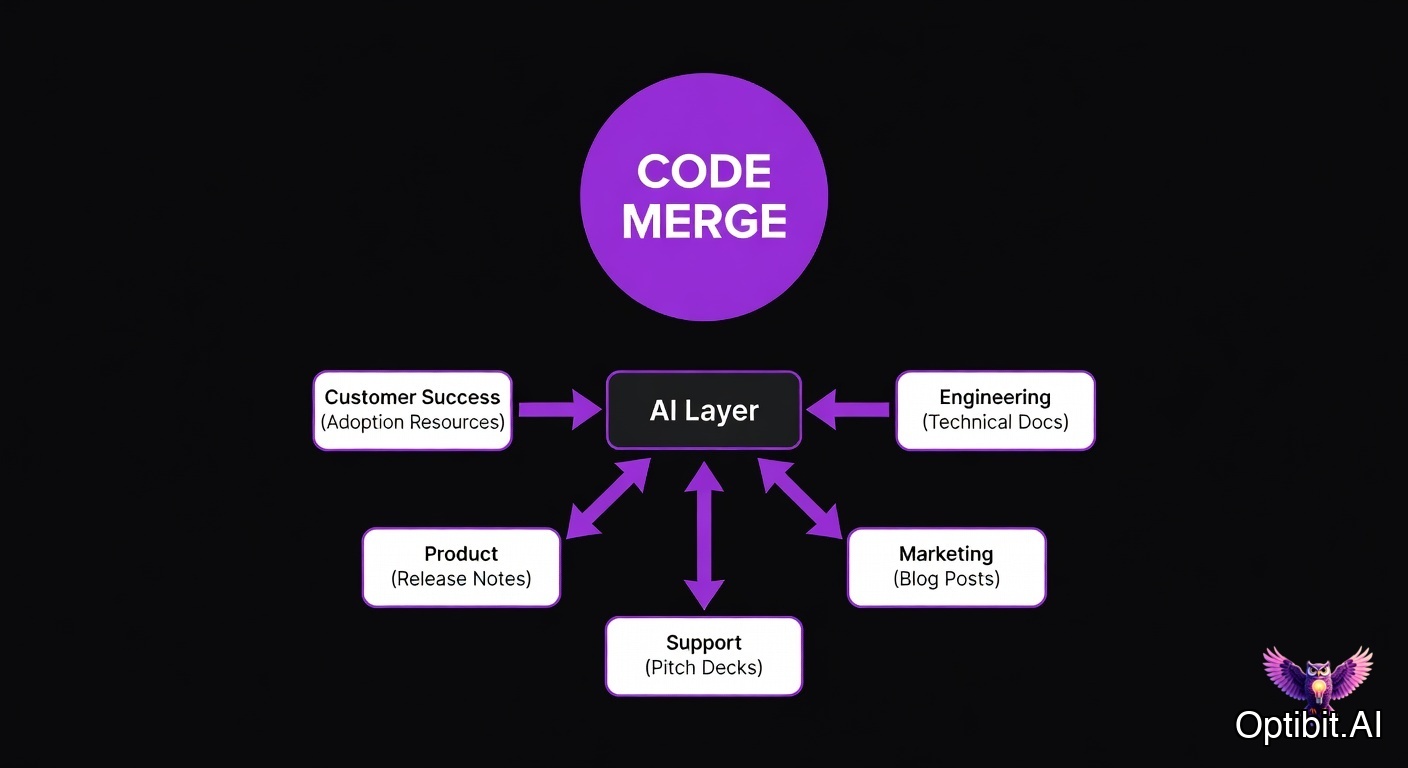
All from the same release. All accurate. All simultaneous.
Organization-Agnostic
We work for 10-person startups where one person wears three hats. We work for 1000-person enterprises with 15 departments. The workflow is the same.
When code ships, information flows. Doesn't matter if "marketing" is one person or 50. Doesn't matter if sales and customer success are the same team or separate orgs. The work determines the flow, not the org chart.
Scales With Velocity, Not Headcount
Ship one feature a month? OptibitAI handles it. Ship ten features a week? OptibitAI handles it at the same cost, same speed, same accuracy.
You don't need to hire more coordinators. You don't need more "integration specialists." You don't need bigger teams to handle higher velocity.
The workflow scales automatically because it's built on automation, not human handoffs.
What This Means for Enterprise Software
The shift from role-based to flow-based tools is not just about OptibitAI. It's a fundamental change in how enterprise software will be built over the next decade.
Here's what I expect to see:
The Death of Per-Seat, Per-Role Pricing
Pricing based on "how many marketers do you have" or "how many engineers do you have" won't make sense when tools serve workflows, not roles.
New pricing models will emerge based on throughput (how many releases, how many workflows, how much information flow) rather than headcount.
Cross-Functional Platforms Over Point Solutions
The "best of breed" strategy (buy the best tool for each department, integrate them yourself) will lose to "best workflow" platforms that are designed for cross-functional work from day one.
Companies will consolidate tool sprawl not by buying fewer point solutions, but by buying platforms that serve multiple roles within a single workflow.
AI as the Integration Layer
Instead of building integrations between systems (Zapier connecting Tool A to Tool B to Tool C), AI will act as the translation layer.
One system holds the truth. AI generates the outputs every other system needs. No integration APIs. No webhook complexity. Just: read the source, write the outputs.
Information Access as a Competitive Advantage
The companies that win won't be the ones with the "best tools per department." They'll be the ones where information flows fastest and most accurately across the organization.
Competitive advantage will shift from "we have great tools" to "our teams have the information they need, when they need it, without asking for it."
The Question You Should Ask About Every Tool
Next time you evaluate enterprise software, ask this:
"Is this tool designed for a role, or designed for a workflow?"
If it's designed for a role:
- Who else will need access to its information?
- How will that information get to them?
- What happens when our org structure changes?
- How much manual work will this create for cross-functional collaboration?
If it's designed for a workflow:
- Does it follow the actual flow of work, or our current org chart?
- Can it serve everyone who needs information, regardless of their role?
- Does it reduce coordination overhead, or just move it to a different tool?
- Will it scale with our velocity, or with our headcount?
The tools that answer "workflow" are the ones that will still be useful when you reorganize in 18 months. The tools that answer "role" are the ones you'll be migrating away from.
The Future Is Flow-Based
The role-gated software era made sense when work was departmental and slow. Engineering shipped once a quarter. Marketing had weeks to prepare announcements. Sales learned about new features in training sessions.
That world is gone.
Modern product companies ship continuously. Features go out daily, sometimes hourly. Marketing needs to keep up. Sales needs to know immediately. Support needs real-time information. Cross-functional teams operate in tight feedback loops.
You can't do that with tools designed for org charts. You need tools designed for workflows. Tools that follow the work, not the department structure. Tools that scale with velocity, not headcount.
AI makes this possible. Not AI as "a chatbot in your tool." AI as the fundamental architecture: read the source of truth, generate outputs for everyone who needs them, deliver simultaneously.
The companies that adopt flow-based tools will move faster, coordinate better, and scale more efficiently than companies still stuck in the role-based era.
The question is: which era is your tool stack designed for?
Published: April 8, 2026
Related Articles
The Horizontal AI Problem
Why today's AI agents struggle with multi-step workflows that require deep understanding across multiple domains.
The Feature Launch Gap
Why most feature launches fail in the critical 72-hour window between code ship and market awareness.