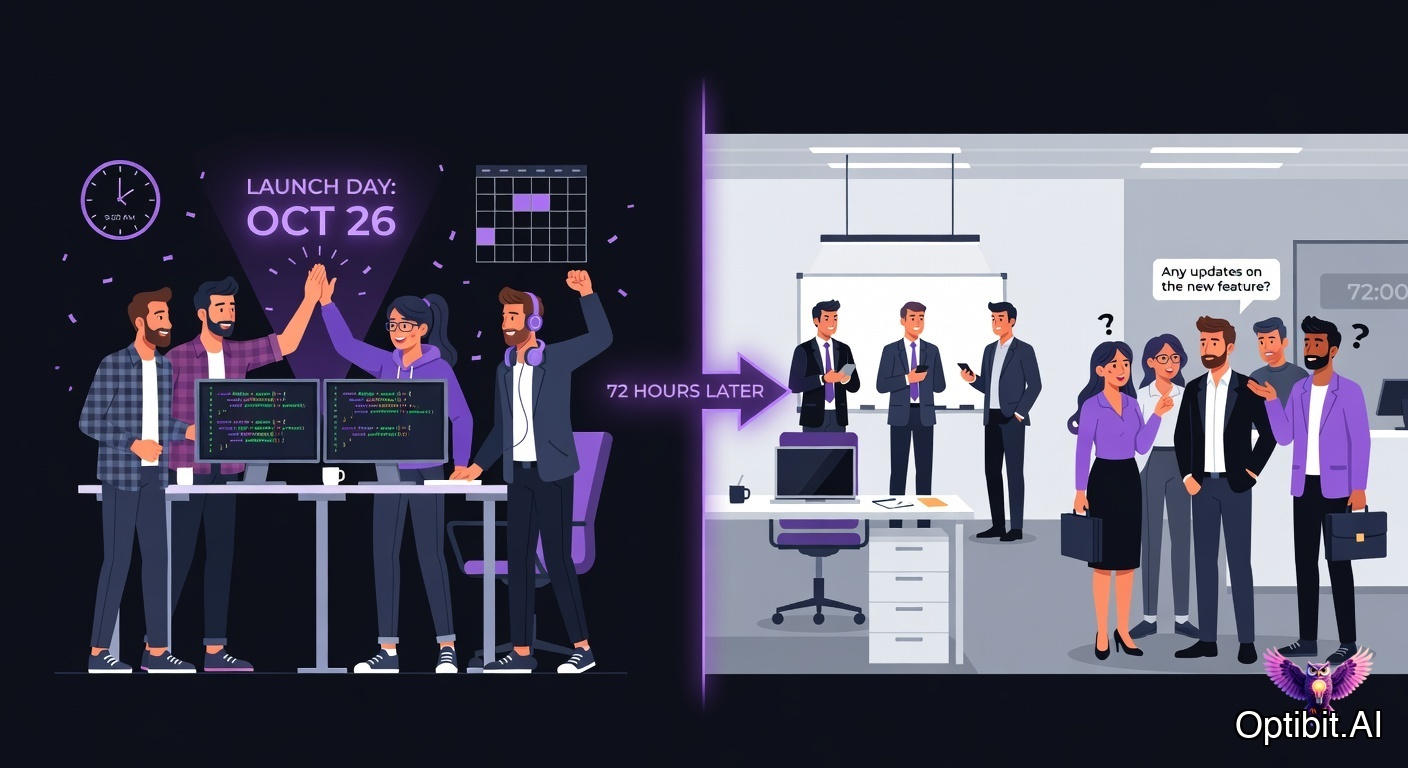
The Feature Launch Gap: Why Your Best Updates Die in Silence
You shipped a feature that took six weeks to build. Engineering celebrated. Product marked it "done" in the roadmap. The release went out on schedule.
Three weeks later, your VP of Sales asks: "Do we have SSO yet?" You do. You shipped it 21 days ago. Nobody told them.
This is the feature launch gap. The space between "we shipped it" and "the market knows about it." Most companies think the gap is measured in days. It's not. It's measured in broken handoffs, missed context, and revenue lost to silence.
I've watched this pattern destroy product velocity at four companies. You ship features faster than your competitors. You announce them slower. Your engineering team runs at full speed while your go-to-market motion limps three weeks behind. By the time customers hear about a feature, you've already shipped two more that they'll never know existed.
The 72-Hour Window
Here's what most product teams don't realize: feature launches succeed or fail in the first 72 hours after the code ships.
Not 72 hours after you announce it. 72 hours after engineering merges to main.
In those 72 hours, one of three things happens:
- Full launch coordination: Engineering ships, marketing announces, sales gets talking points, support gets KB articles, customers hear about it. The feature lands in the market with momentum.
- Partial launch: Engineering ships, marketing eventually writes something, sales hears about it in a meeting two weeks later, support learns about it from customer tickets. The feature exists but adoption is slow.
- Silent launch: Engineering ships, nobody else finds out until someone asks "do we have this?" months later. The feature might as well not exist.
The difference between these outcomes isn't product quality. It's not market timing. It's whether you can close the gap between code commit and coordinated announcement in under 72 hours.
Most companies can't. Here's why.
Anatomy of a Failed Launch
Let me walk you through what a failed feature launch actually looks like. This is a real example from a 300-person B2B SaaS company I worked with (details changed for confidentiality).
Monday, 9 AM: Engineering Ships
The team ships a major integration with Salesforce. Customers have been asking for this for 18 months. The feature works. It's in production. Engineering posts in #engineering-wins on Slack.
Monday, 11 AM: Product Sees It
Product manager sees the Slack post. Realizes they forgot to tell marketing this was shipping today. Sends a DM: "Hey, we shipped Salesforce integration, can you write something?"
Tuesday, 10 AM: Marketing Responds
Marketing: "Great! Can someone send me details? What exactly does it do? Who's it for? What's the positioning vs. HubSpot integration?" Product manager is in back-to-back meetings. Responds with a Loom video at 4 PM.
Wednesday, 2 PM: Marketing Drafts Blog Post
Marketing watches the Loom, drafts a blog post. Sends to product for review. Product manager has 15 edits. Sends it back Thursday morning.
Friday, 11 AM: Blog Post Published
Blog post goes live. No email announcement (that's scheduled for the monthly newsletter). No social media (waiting for design to make graphics). Sales hasn't heard about it yet (launch meeting is Monday).
Monday (8 days later): Sales Learns About It
Sales gets a 15-minute overview in the weekly product sync. Half the team is multitasking. Someone asks: "Can we use this in demos?" Answer: "We don't have a demo script yet, but you can improvise."
Week 3: Customer Finds Out
A customer stumbles on the blog post while searching for something else. Emails their rep: "Do you have Salesforce integration?" Rep: "Let me check." (They've had it for three weeks.)
Total time from ship to market awareness: 21 days.
Total time competitors needed to react: 0 days. (They didn't know you shipped it either.)
This isn't a failure of effort. Everyone in this story is working hard. It's a failure of coordination. The gap between "code merged" and "everyone knows what we shipped" is too wide to cross manually.
Why the Gap Exists
The feature launch gap exists because most companies treat launches as a sequence of handoffs instead of a parallel distribution problem.
Here's the sequence model (what most companies do):
Sequential Launch Model
Engineering ships → tells Product → Product tells Marketing → Marketing writes blog → sends to Sales → Sales updates decks → tells Customer Success → CS tells customers
Total time: 2-4 weeks
Information loss at each handoff: 20-30%
Every handoff introduces delay. Every handoff loses context. By the time the customer hears about the feature, the story has been through six rounds of telephone.
Here's what the parallel model looks like (what high-velocity companies do):
Parallel Launch Model
Engineering ships → automated content generation creates:
- Technical docs (for engineering)
- Blog post draft (for marketing)
- Sales talking points (for sales)
- KB articles (for support)
- Release notes (for product)
Total time: Same day
Information loss: 0% (all generated from source code)
The difference isn't people. It's architecture. Sequential models can't close the gap because information doesn't flow fast enough. Parallel models eliminate the gap by distributing information simultaneously.
The Three Failure Modes
When I analyze failed feature launches, they almost always fit one of three patterns:
1. The Surprise Launch
Engineering ships something that product and marketing didn't know was coming this week. Maybe it was scheduled for next sprint. Maybe an engineer knocked it out early. Maybe there was a miscommunication.
Result: GTM scramble. Marketing writes a hasty blog post. Sales gets a Slack summary. Support has no documentation. Customers find the feature via trial and error.
This happens when your launch coordination is based on calendar dates instead of code commits. If your launch plan says "we'll announce the Salesforce integration on March 15th," but engineering ships it on March 8th, you have a seven-day gap. In fast-moving product orgs, the gap is often longer because engineering ships ahead of schedule.
2. The Partial Launch
Engineering ships. Marketing writes a blog post. That's it. Sales never gets talking points. Support doesn't get training. Customer success doesn't get a heads-up. Customers read the blog post and ask their rep about it. The rep has no idea what they're talking about.
This happens when launch responsibility is siloed. Marketing owns "the announcement," so they write a blog post and call it done. But an announcement isn't a launch. A launch means every customer-facing team has the information and tools they need to talk about the feature on day one.
I've seen this destroy potentially game-changing features. You ship something that solves a problem your biggest competitor can't address, but only marketing knows about it. Sales keeps selling the old story. Customers who ask about the new capability get blank stares from support. Six months later, leadership asks: "Why isn't anyone using this feature?" Because nobody told them it exists.
3. The Invisible Launch
Engineering ships. Nobody announces it. Not because they're lazy, but because it's a "minor" update. Just a bug fix. Just an API improvement. Just a small quality-of-life enhancement.
Except it's not minor to the customer who's been working around that bug for eight months. It's not minor to the sales rep who lost a deal because the API didn't support bulk imports. It's not minor to the support engineer who's been manually helping customers with that quality-of-life issue twice a day.
This happens when launch/no-launch is a binary decision based on "feature size" instead of customer impact. If you only announce "major features," you're leaving dozens of valuable improvements undiscovered every quarter.
The Coordination Tax
Here's the dirty secret about feature launches: the hard part isn't building the feature. The hard part is coordinating everyone who needs to know about it.
At a 200-person product company, a single feature launch touches:
- 3-5 engineers (who built it)
- 1-2 product managers (who spec'd it)
- 1-2 designers (who designed it)
- 2-3 marketing people (who need to announce it)
- 15-40 sales reps (who need to sell it)
- 5-10 support engineers (who need to troubleshoot it)
- 3-5 customer success managers (who need to help customers adopt it)
That's 30-65 people who need coordinated, accurate information about what shipped and why it matters.
If you do this manually, someone needs to:
- Write an internal summary of the feature
- Schedule a launch meeting (or five separate meetings for different teams)
- Create talking points for sales
- Write a blog post for marketing
- Draft KB articles for support
- Update product docs for customer success
- Prepare a demo script
- Update sales decks
- Write release notes
That's 20-30 hours of coordination work for a single feature. If you ship 2-3 features per week, that's 40-90 hours per week spent on launch coordination. That's 2-3 full-time people doing nothing but translating "what engineering built" into "what everyone else needs to know."
Most companies don't budget for this. So it doesn't get done. Or it gets done poorly. Or it gets done late. And the gap widens.
Why Speed Matters
You might think: "Okay, it takes three weeks to coordinate a launch. So what? The feature still gets announced eventually."
Here's why the three-week gap matters:
1. Lost Competitive Windows
You shipped a feature your competitor doesn't have. For 21 days, nobody knows. Your competitor announces a similar (worse) feature on day 14. Now the market thinks they beat you to it. You had a seven-day head start that you wasted in silence.
2. Degraded Customer Trust
A customer asks if you support SSO. You say "not yet" because you don't know it shipped yesterday. They sign with a competitor. A week later, you send them a marketing email: "Introducing SSO!" They don't respond. They're already gone.
3. Support Chaos
You ship a feature. Customers find it. They have questions. Support doesn't know it exists. They tell customers "we don't have that feature" while linking to documentation that now describes it. Customer confidence craters.
4. Sales Pipeline Damage
A prospect is comparing you to a competitor. The feature you just shipped is the tiebreaker. Your sales rep doesn't know about it. They lose the deal. You find out three months later when you analyze lost opportunities.
5. Wasted Engineering Effort
You built something valuable. Nobody uses it because nobody knows it exists. Six months later, a customer requests it as a feature. You tell them you've had it for half a year. They're confused and frustrated. So is your engineering team, who wonders why they're building features nobody discovers.
The feature launch gap isn't just a coordination problem. It's a revenue problem. Every day between ship and announcement is a day your investment in that feature isn't generating returns.
How High-Velocity Companies Close the Gap
The companies that close the feature launch gap don't do it by hiring more coordinators. They do it by eliminating the coordination bottleneck.
Here's what that looks like:
This isn't theoretical. I've watched companies go from 21-day launch cycles to same-day launches by automating content generation from code.
The pattern is simple:
- Engineering merges a PR to main
- AI analyzes the changes (what functions changed, what's user-facing, what APIs are new, what problems this solves)
- Generate role-specific content from the same source:
- Customer-facing blog post (benefits, use cases, screenshots)
- Sales enablement doc (competitive positioning, objection handling, demo script)
- Support KB article (how to use it, troubleshooting steps, known limitations)
- Technical documentation (API changes, code examples, migration guides)
- Release notes (what changed, why it matters, action items)
- Human teams review and refine (not write from scratch)
The key insight: you're not replacing human judgment. You're eliminating the manual translation work. Marketing still reviews the blog post. Sales still adds their insights. Support still refines the troubleshooting steps. But they're editing 80% complete drafts instead of starting from Slack summaries and vague memories.
What This Looks Like in Practice
Last month, we shipped a feature at OptibitAI that touched 23 pull requests across three repos. In the old world (manual coordination), here's what would have happened:
- Engineering posts in Slack: "Shipped the bulk export feature"
- Product manager writes an internal summary (2 hours)
- Marketing reads the summary, asks questions, drafts blog post (6 hours)
- Sales watches a demo, updates pitch deck (4 hours)
- Support reads the blog draft, writes KB articles (5 hours)
- Customer success prepares talking points (2 hours)
Total: 19 hours of coordination work, spread across 5 days.
With automation (OptibitAI in our case), here's what actually happened:
- Engineering merges the final PR
- OptibitAI analyzes all 23 PRs and generates:
- Blog post with customer benefits and use cases
- Sales deck slides with competitive positioning
- Support KB article with step-by-step usage guide
- Technical docs with API examples and code snippets
- Release notes with "what changed" and "why it matters"
- Marketing reviews blog post, makes light edits, publishes (30 minutes)
- Sales reviews deck, adds custom talking points (15 minutes)
- Support reviews KB, adds troubleshooting tips (20 minutes)
Total: 65 minutes of human review, same day.
The feature shipped at 11 AM. By 3 PM, the blog post was live, sales had updated decks, support had KB articles ready, and customers were reading the announcement.
No coordination meetings. No Slack threads. No game of telephone. Just one source of truth (the code) flowing to everyone who needed it in the format they needed.
Closing the Gap
If your feature launches are dying in the gap between ship and announcement, you have two choices:
Option 1: Hire more coordinators. Add product marketers, technical writers, sales enablement managers. Have them manually translate every release into content for every team. Accept that this will slow down as you ship faster. Budget 20-30 hours per feature. Hope they can keep up.
Option 2: Eliminate the gap. Automate content generation from code. Give every team what they need the moment you ship. Scale your launch coordination to match your engineering velocity. Turn the 72-hour window into a 72-minute window.
Most companies choose Option 1 because it's the default. They don't realize Option 2 is possible until they watch a competitor announce features the same day they ship them.
The feature launch gap isn't inevitable. It's a choice. You can choose to coordinate manually and accept the three-week lag. Or you can choose to automate the content pipeline and close the gap completely.
Your engineering team is shipping. The question is: how long until the market finds out?
Published: April 7, 2026