The Horizontal AI Problem: When Engineering Gets AI But Everyone Else Waits
I spent three years watching this pattern play out at a 650-person product org. Engineering got GitHub Copilot and started shipping 40% faster. Design adopted Midjourney and cut mockup time in half. Marketing brought in Jasper for blog posts. Every department celebrated their AI win.
Then someone asked a simple question in a product review: "Why does it take us four days to launch something we built in three hours?"
The answer wasn't about code velocity or creative output. It was about the gap between tools. Engineering's AI knew what shipped. Marketing's AI had no idea. Sales was manually updating decks from Slack threads. Support was writing KB articles from screenshots of PRs.
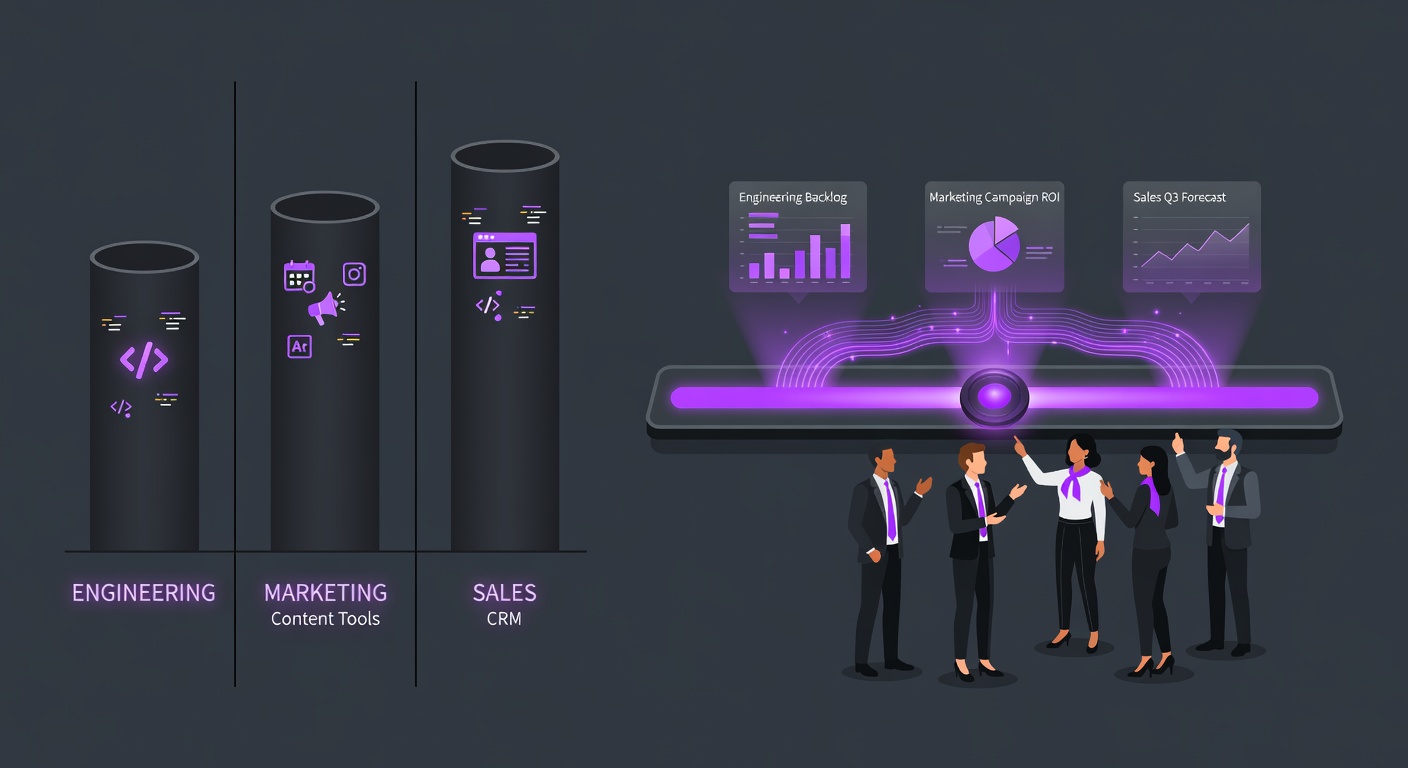
We had built the perfect set of vertical AI silos.
Vertical AI vs. Horizontal AI
Most enterprise AI deployments follow the same pattern. You identify a role with a clear, repetitive workflow. You buy (or build) an AI tool that makes that specific role more productive. Engineering gets code completion. Marketing gets content generation. Sales gets email drafting.
This is vertical AI deployment. You're going deeper into a single role's capabilities. The AI learns the patterns of that function, trains on domain-specific data, and delivers increasingly sophisticated outputs for that one use case.
It works. Productivity goes up. Teams love it.
But here's what breaks: the flow of information across your organization.
When engineering ships a new feature, that information needs to propagate to at least six different teams:
- Technical docs need API documentation
- Marketing needs a blog post announcement
- Sales needs updated pitch decks
- Support needs new KB articles
- Customer success needs talking points
- Product marketing needs release notes
In a vertically-deployed AI world, each team uses their own tool to create their own artifact from scratch. Marketing's AI doesn't know what engineering's AI just built. Sales is working from a Slack summary. Support is reverse-engineering the feature from the UI.
Everyone has AI. Nobody has the same context.
Horizontal AI scaling solves this differently. Instead of giving each team a deeper tool for their specific role, you give every team access to the same source of truth and let the AI generate role-specific outputs from that shared context.
One release. One set of code changes. Multiple outputs, each tailored to the team that needs it.
Why Vertical AI Creates Bottlenecks
The problem with vertical AI isn't that it doesn't work. It's that it works too well for one team and creates a new constraint everywhere else.
I've seen this at three companies now. Engineering adopts AI-assisted coding and doubles their release frequency. Great, right? Except now marketing can't keep up with launch announcements. Sales decks are always two releases behind. Support is fielding tickets about features that have no documentation yet.
The AI made one part of the system 10x faster, but the bottleneck just moved downstream.
This happens because vertical AI tools are designed around role-based workflows, not information workflows. They optimize for "how does a marketer write a blog post?" instead of "how does information about a release propagate to everyone who needs it?"
You end up with:
- Context fragmentation: Every team interprets the release differently because they're working from different sources (Slack, screenshots, verbal summaries).
- Redundant effort: Five people are writing about the same feature in five different tools, starting from scratch each time.
- Timing misalignment: Engineering ships on Monday. Marketing publishes on Thursday. Sales updates decks the following week. The customer sees three different stories.
- Quality drift: By the time information passes through four handoffs, technical details are wrong, benefits are overstated, and limitations are missing.
The more productive your vertical AI tools make individual roles, the more painful these gaps become.
The Case for Organization-Wide AI Enablement
Here's what changed when we shifted to organization-wide AI enablement:
Instead of asking "what AI tool does marketing need?" we asked "what information does everyone need when engineering ships a release?"
The answer was simple: they all need to know what changed, why it matters, and how it impacts their function. But they need it in different formats.
Engineering needs technical specifics: API changes, breaking changes, migration paths.
Marketing needs the customer story: what problem does this solve, who benefits, what's the business value.
Sales needs objection handling: how does this compare to competitors, what's the pricing impact, what's the ideal customer profile.
Support needs troubleshooting content: common issues, configuration steps, known limitations.
Same release. Four completely different artifacts. And all of them need to be consistent with each other.
That's what horizontal AI scaling enables. You point the AI at the source of truth (the code, the PRs, the commits), and it generates every artifact from that same context. Marketing's blog post and engineering's technical docs are describing the exact same feature because they came from the exact same input.
Real Example: 47 PRs to Full Launch Package
Last month we shipped a major feature that touched 47 pull requests across six repos. In the old world (vertical AI), here's what would have happened:
- Engineering writes release notes (2 hours)
- Someone summarizes the PRs in Slack (30 minutes)
- Marketing reads the Slack thread and drafts a blog post (4 hours)
- Sales reads the blog draft and updates pitch deck (3 hours)
- Support watches a demo and writes KB articles (6 hours)
- Product marketing synthesizes everything into release notes (2 hours)
Total: 17.5 hours, spread across 4 days, six people.
With horizontal AI (OptibitAI in our case), we pointed it at the 47 PRs and got:
- Technical documentation with API changes and code examples
- Marketing blog post with customer benefits and use cases
- Sales deck updates with competitive positioning
- Support KB articles with troubleshooting steps
- Product release notes with feature summary
Total: 11 minutes, same day, zero handoffs.
Every artifact was fact-checked against the actual code. Every team got exactly what they needed. And because it all came from the same source, there were no contradictions between marketing's claims and engineering's docs.
Democratizing AI Access
The other shift that matters: role-gating vs. democratization.
Vertical AI tools are often licensed per role. Copilot for developers. Jasper for marketers. Gong for sales. This makes sense from a product pricing perspective, but it creates artificial barriers to information access.
What if your sales engineer needs to understand a technical implementation detail? They can't use the engineering AI tool. What if your product manager wants to draft a blog post? They don't have access to the marketing AI.
Horizontal AI enablement removes these gates. If the AI is generating artifacts from a shared source of truth, anyone in the organization can access the output they need, regardless of their role.
A sales engineer can read the technical docs. A product manager can review the marketing blog. A support lead can see the sales positioning. Everyone has visibility into the same release, just formatted for their context.
This is what true organization-wide AI enablement looks like. Not "everyone gets an AI tool," but "everyone gets access to AI-generated insights about the work that matters to them."
What This Means for Enterprise AI Strategy
If you're building or buying AI tools for your organization, here are the questions worth asking:
- Does this AI create new silos or connect existing ones? Tools that only serve one role will increase productivity for that role but create handoff bottlenecks everywhere else.
- Can this AI scale horizontally across teams? The best enterprise AI investments are the ones that propagate information across your org, not just deepen capability in one function.
- What's the source of truth? If your AI tools are generating content from summaries, Slack threads, or meeting notes, you're building on a lossy foundation. Go to the source (code, data, systems of record).
- Who has access to the outputs? If only one team can see what the AI generates, you're still creating information asymmetry.
The companies that figure out horizontal AI scaling will have a massive operational advantage. Not because their individual contributors are more productive (though they will be), but because their organizations will eliminate entire categories of coordination overhead.
No more "sync meetings" to align on launch messaging. No more Slack threads trying to summarize what shipped. No more version drift between what sales says and what engineering built.
Just one source of truth, flowing to everyone who needs it, in the format they need it.
How We Do This at OptibitAI
This entire post is written from experience building and using OptibitAI, which was designed specifically to solve this horizontal scaling problem for GTM content.
We connect to your repos, analyze code-level changes in every release, and generate:
- Technical documentation for engineering teams
- Blog posts and announcements for marketing
- Sales deck updates with positioning and objection handling
- Support KB articles with troubleshooting steps
- Product release notes with feature summaries
All from the same release. All fact-checked against the actual code. All delivered the day you ship.
It's not about replacing your team's expertise. It's about eliminating the manual translation work between "what we built" and "what everyone needs to know about it."
If your organization is struggling with GTM lag, content debt, or cross-functional misalignment after releases, this is the problem we solve.
Published: April 5, 2026