The Changelog No One Reads: Why 'What's New' Pages Are Where Features Go to Die
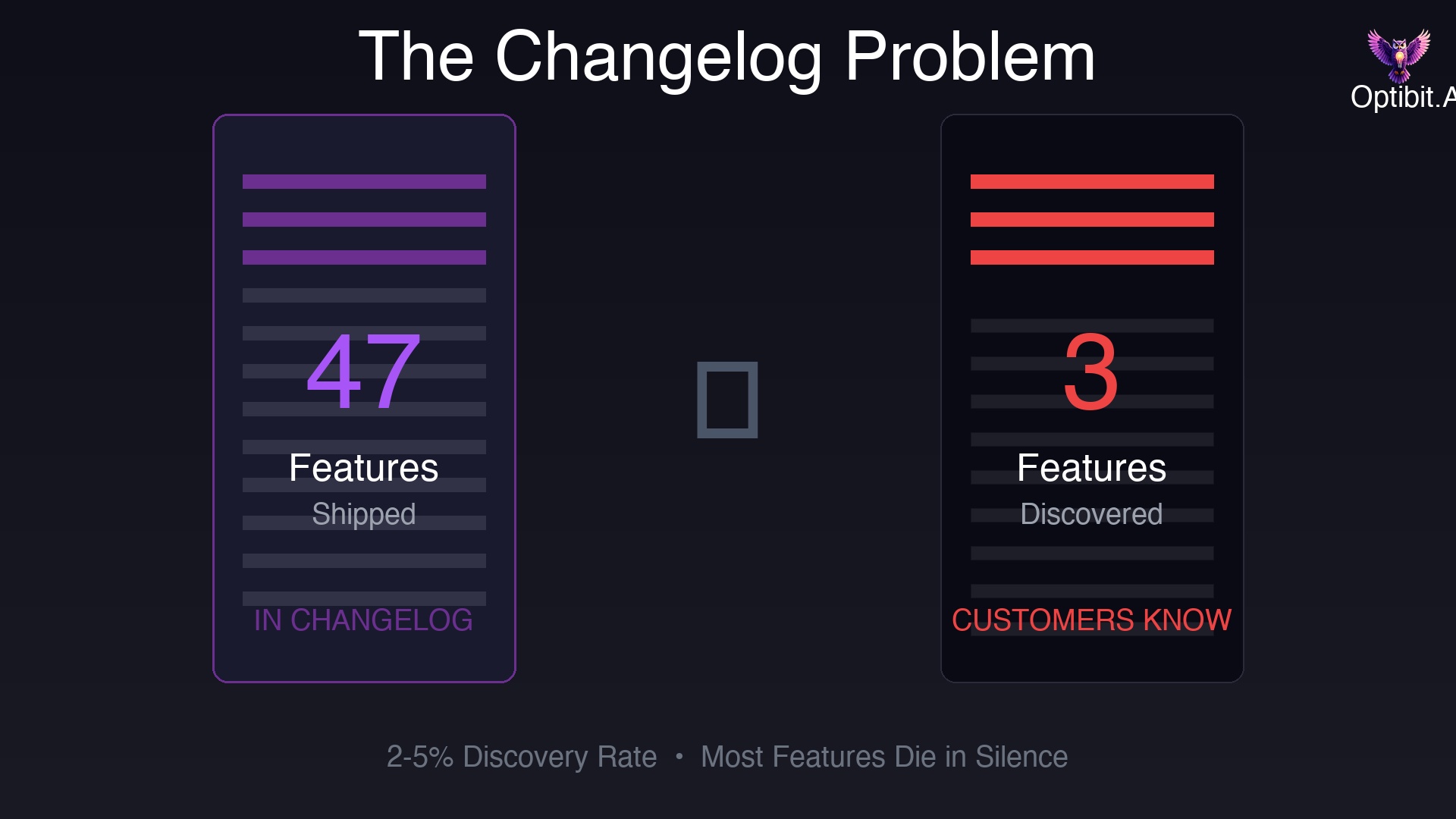
You shipped 47 features last quarter. Engineering crushed every sprint goal.
Your customers know about 3 of them.
The other 44? Buried in a changelog nobody reads. This is where features die. Not in production. In aggregation.
The Numbers Don't Lie
The Brutal Truth
- 2-5% of active users ever visit your changelog
- 0.3% read more than one entry
- 12 seconds average time on changelog pages
- 92% of features in roundup emails never get clicked
- 6 months before customers discover features they need
The changelog exists to make product teams feel better, not to inform customers. It's a filing system disguised as a communication channel.
Why Aggregation Kills Discovery
The changelog model assumes people will visit one page to see what's new. They won't. Here's why:
The Relevance Problem
Your changelog lists 47 features. A typical user cares about 3-5. When you aggregate everything, users scan the first few items, see nothing relevant, and leave. The features they needed were #11, #23, and #38. They never scrolled that far.
The Timing Problem
Feature ships March 3rd. Changelog publishes March 31st. For 28 days, it's invisible. Customers who needed it on March 5th implement a workaround or adopt a competitor. By the time you announce it, the moment has passed.
The Context Problem
Your entry says "Added SSO support for Okta." It doesn't say why enterprises care, how it solves the password problem, or which pain points it addresses. Changelogs tell WHAT changed, not WHY it matters.
Real Examples
The $500K Feature Nobody Found
SaaS company shipped API rate limit increases. Unlocked enterprise use cases. Line item #7 in the changelog.
Result: Three enterprise deals ($500K ARR) chose a competitor because "your API can't handle our volume." Sales didn't know the limits had increased. It was in the changelog. Nobody read it.
The Feature Customers Kept Requesting
Project management tool shipped Gantt PDF export. Most requested feature for 18 months. Listed in March changelog.
Result: Support received 15-20 tickets per week asking "when will you add PDF export?" for the next 4 months. Customers were requesting something they already had.
The Innovation That Looked Like Copying
Analytics platform shipped AI anomaly detection in June. First in category. Item #12 of 23 in the changelog.
Result: Competitor shipped similar feature in August with blog post, webinar, and press release. Market saw them as innovator. They were 2 months behind but announced it better.
What Actually Works
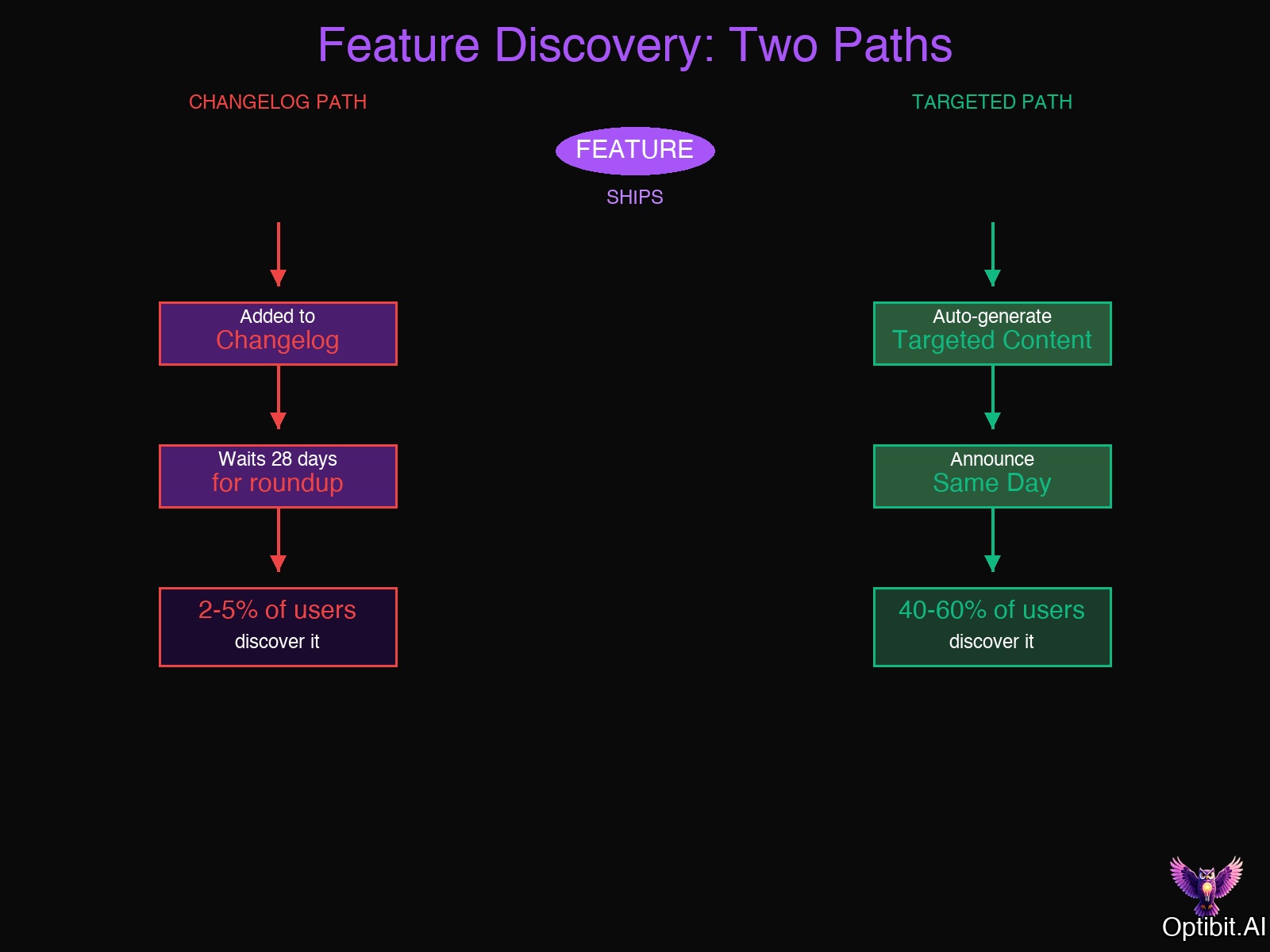
Companies that win on feature adoption don't aggregate. They personalize. They don't batch. They communicate continuously. They don't list features. They tell stories.
Relevance Over Completeness
Show each user what matters to them. API users get API updates. Dashboard users get UI updates. One targeted message beats ten irrelevant ones.
Continuous Over Batched
Announce features when they ship, not when the calendar says it's time. Ship SSO on Tuesday? Tell enterprise customers on Wednesday. The moment of shipping is the moment of maximum relevance.
Story Over Specification
Don't say "Added SSO support." Say: "Your IT team asked for single sign-on so employees don't have to remember another password. We built it. Security compliance just got easier."
Same feature. Different framing. Stories get remembered. Specs get skimmed.
Multi-Channel Over Single-Page
Bring updates to where users already are: in-app notifications, personalized emails, sales talking points, support KB articles. One feature, five formats, delivered where they'll actually see it.
The OptibitAI Approach
Traditional model: Engineering ships. Everyone waits for the changelog. Copies info. Reformats. Announces weeks later.
OptibitAI model: Code merges. Targeted content generates automatically for every audience.
- Engineering: Technical docs with API changes
- Marketing: Blog post explaining the problem solved
- Sales: Talking points with competitive positioning
- Support: KB article with troubleshooting
- Customers: Personalized emails and in-app notifications
All from the code. All accurate. All delivered the day it ships. No changelog required.
Before: Monthly changelog. 8% feature adoption within 3 months.
After: Continuous targeted announcements. 34% adoption within 3 months.
Same features. Different communication. 4x adoption rate.
The Bottom Line
Your changelog is where features die because aggregation kills discovery, batching kills timing, and feature lists kill context.
Companies winning on feature adoption stopped relying on changelogs. They communicate continuously, target specifically, and meet customers where they already are.
Your engineering team ships features. Your changelog buries them. Your customers miss them. Your competitors look more innovative.
The technology to automate targeted communication already exists. The question is: how long will you keep filing valuable features into a page nobody reads?
Try OptibitAI to automatically generate targeted GTM content the moment code merges.
Published: April 9, 2026