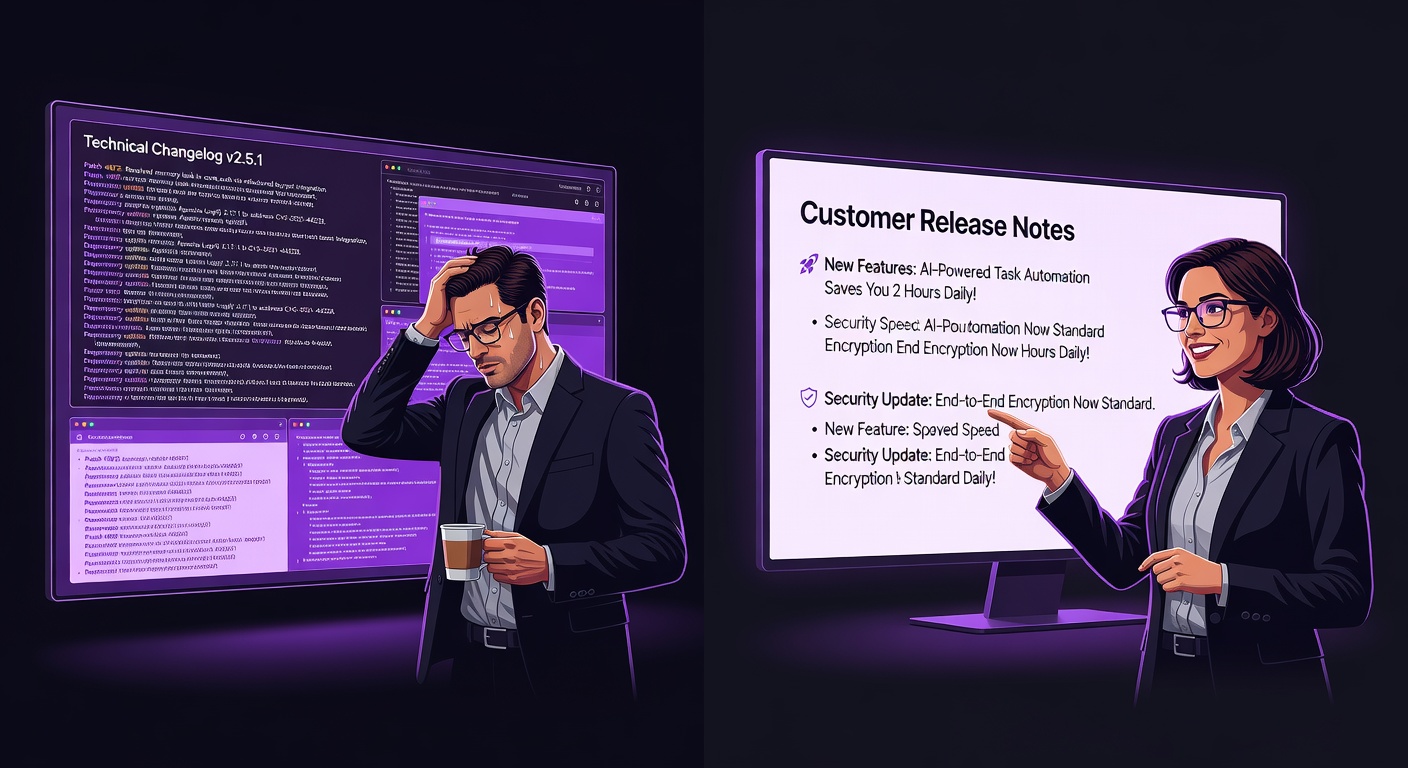
The Release Notes Problem: Why Your Product Updates Go Unread
You shipped 15 features last quarter. How many customers actually know about them?
If you're like most product teams, the answer is somewhere between "maybe three" and "I have no idea." You wrote release notes. You published them. You checked the box. But nobody read them.
I've seen this pattern at every company I've worked with. Engineering ships. Product marketing scrambles to write release notes. The notes get published to a changelog page that gets 47 views (12 of which are from your own team checking if it's live). Customers keep asking for features you shipped six months ago. Sales has no idea what's new. And the CEO asks in the next all-hands: "Why doesn't the market know what we're building?"
The problem isn't that you're not writing release notes. The problem is you're writing the wrong release notes for the wrong audience in the wrong format.
The Release Notes Graveyard
Most release notes end up in what I call the Release Notes Graveyard. A changelog page buried three clicks deep in your product docs, written in language that only engineers understand, updated sporadically, and read by almost no one.
Here's what typically happens:
- Engineering ships a feature
- Product manager writes a one-liner: "Added support for SSO integration"
- Release notes get published to the changelog
- Email notification goes out with the subject line "Product Update - Q1 2026"
- Customers see a wall of technical jargon and close it
- Three months later, a customer asks: "Do you support SSO?"
Sound familiar?
The issue is that release notes are treated as a single artifact for a single audience. But a product release has at least four different audiences, each needing completely different information:
- Customers need to know what problem this solves and why they should care
- Sales needs competitive positioning and deal-closing talking points
- Support needs troubleshooting steps and known limitations
- Engineering needs technical details, API changes, and migration paths
One set of release notes can't serve all four. So you end up with release notes that serve none of them well.
The Two Audiences Problem
Let me show you what I mean. Here's a real release note I saw at a SaaS company (lightly edited):
Bad Example: Engineering-Focused
v2.4.0 - API Gateway Refactor
Implemented OAuth 2.0 PKCE flow with support for custom identity providers. Deprecated legacy session-based auth. Breaking change: /api/v1/auth endpoints removed. Migrate to /api/v2/auth before June 1st.
This release note is technically accurate. It tells you exactly what changed. And it's completely useless to 95% of the people who should care about it.
A customer reading this sees: "We changed something technical. It might break your integration. Good luck."
A salesperson sees: "I have no idea how to sell this."
A support engineer sees: "Great, angry customers incoming and I don't know how to help them."
Here's the same release, written for a customer:
Good Example: Customer-Focused
More Secure Authentication with Your Existing Identity Provider
You can now use your company's existing identity provider (Okta, Azure AD, Google Workspace, etc.) to securely log into our platform. This means:
- No more separate passwords for your team to remember
- Centralized access control through your existing IT systems
- Enhanced security with modern authentication standards
Action required: If you're currently using our legacy authentication, you'll need to upgrade by June 1st. Our support team will walk you through the 10-minute migration process. Schedule your migration call here.
Same feature. Completely different story. The second version tells customers what they get, why it matters, and what they need to do.
But here's the kicker: you need both versions. Engineering needs the technical details. Customers need the benefits. Sales needs the positioning. Support needs the troubleshooting guide.
Most companies pick one and hope it works for everyone. It doesn't.
The 48-Hour Window
There's another problem with release notes that nobody talks about: the knowledge decay window is incredibly short.
When engineering ships a feature, there's a 48-hour window where the people who built it have full context. They know why decisions were made, what edge cases exist, what customers it's designed for, and how it compares to competitors.
After 48 hours, that context starts to fade. After a week, it's fragmented. After two weeks, you're asking engineers to remember details about a feature they shipped between three other releases.
But release notes are usually written by product marketing, not engineering. And product marketing gets their information from engineering in one of three ways:
- A Slack thread summary (lossy)
- A 15-minute handoff call (incomplete)
- Reading the PRs themselves (time-consuming and error-prone)
By the time the release notes are written, the context is already degraded. Technical accuracy drops. Key benefits get missed. Competitive differentiators are forgotten.
I watched this happen at a 400-person product company. Engineering shipped a major feature that solved a problem their biggest competitor couldn't address. But by the time product marketing wrote the release notes two weeks later, that competitive angle was lost. The release notes described what the feature did, but not why it mattered. Sales had no ammunition. Customers didn't realize they'd just gotten a major advantage. The feature launched with a whimper.
The 48-hour window is real. If you're not capturing context immediately, you're writing release notes from reconstruction, not reality.
What Good Release Notes Actually Look Like
Let me show you what role-specific release notes look like for the same feature: a new analytics dashboard.
For Customers
See Your Product Usage in Real-Time
You can now track how your team uses our platform with a new analytics dashboard. See who's active, which features get the most use, and where your team might need training.
Perfect for team leads who need visibility without constant check-ins.
For Sales
Analytics Dashboard - Competitive Advantage
Unlike Competitor X (requires Enterprise plan) and Competitor Y (30-day delay), our analytics update in real-time and are available on all plans.
Key objection handler: "Do you offer usage analytics?" → Yes, real-time, all plans, available today.
For Support
Analytics Dashboard - Troubleshooting Guide
Common issues:
- Data not showing: Check permissions (Admin required)
- Missing users: SSO users sync hourly (not real-time)
- Export timing out: Limit to 90-day ranges
For Engineering
Analytics Dashboard - Technical Details
New /api/v2/analytics endpoints. GraphQL schema updated with usageMetrics type.
Breaking changes: None
Migration: Not required
Same feature. Four completely different artifacts. Each one optimized for its audience.
This is what good release notes look like. Not one generic announcement, but a suite of tailored communications.
The Cost of Bad Release Notes
Bad release notes aren't just annoying. They have real business costs:
1. Invisible Innovation
If customers don't know about your new features, they'll assume you're not innovating. I've seen companies lose competitive deals because prospects thought the product was stagnant. The features existed. The release notes were just unreadable.
2. Support Ticket Explosion
When release notes don't explain how something works or what changed, customers flood support with questions. At one company, every major release created a 40% spike in support volume for two weeks. Not because the features were broken, but because the release notes were useless.
3. Sales Enablement Lag
Sales reps can't sell features they don't understand. If your release notes are too technical, sales will ignore them and keep selling last quarter's roadmap. You're shipping faster than your sales team can keep up.
4. Customer Churn from Poor Migrations
Breaking changes with bad release notes are a churn accelerator. Customers wake up to broken integrations, unclear migration paths, and no explanation of why the change was necessary. They don't see an improvement. They see incompetence.
5. Wasted Engineering Effort
The ultimate irony: you spend weeks building a feature, ship it, and then spend the next month answering Slack questions, writing follow-up docs, and explaining it to sales because the release notes didn't do their job.
Why This Is So Hard to Fix
Most companies know their release notes are bad. They just don't know how to fix them without slowing down shipping.
The traditional solutions all have problems:
Option 1: Make engineers write release notes
Engineers are great at explaining how something works. They're less great at explaining why it matters to a customer. You get technically accurate notes that nobody reads.
Option 2: Product marketing writes everything
Product marketing understands the customer, but they don't have deep technical context. They're dependent on engineers for information, and engineers are busy. Result: delays, inaccuracies, and missed details.
Option 3: Hire a technical writer
This helps, but it doesn't solve the core problem: you still have one person trying to write for four audiences. And they're still working from secondhand information.
The fundamental issue is that release notes are a translation problem, not a writing problem. You need to translate code-level changes into customer benefits, competitive positioning, support guidance, and technical documentation.
Doing that manually, for every release, with full context, at the speed your engineering team ships? It's not sustainable.
The Solution: Generate, Don't Write
The only way to fix release notes at scale is to stop writing them manually and start generating them automatically.
Here's what that looks like:
- Code merges to main
- AI analyzes the changes (what functions changed, what's customer-facing, what's an API change, what's a fix vs a new capability)
- Generate four different artifacts from the same source:
- Customer-facing release notes (benefits, use cases, action items)
- Sales talking points (competitive positioning, objection handling)
- Support KB article (troubleshooting, known issues)
- Technical documentation (API changes, migration guides)
- Human review and refinement (not writing from scratch)
The key advantage: you're generating all four artifacts from the code itself, not from a game of telephone. No context loss. No waiting for handoffs. No 48-hour decay window.
And because it's automated, you can do this for every release, not just the "big" ones.
What This Looks Like in Practice
At OptibitAI, we built this because we kept watching companies ship amazing features that nobody knew about.
Now, when a team ships a release:
- OptibitAI analyzes the code changes and pull requests
- Generates customer-facing release notes with benefits and use cases
- Creates sales enablement docs with competitive positioning
- Writes support KB articles with troubleshooting steps
- Produces technical docs with API changes and code examples
All from the same release. All technically accurate (because it's generated from the actual code). All tailored to the audience that needs it.
Product marketing still reviews and refines the customer-facing notes. Sales still adds their insights. But they're editing 80%-complete drafts, not starting from scratch every time.
The Real Cost of Ignored Release Notes
Here's what I wish someone had told me five years ago when I first saw this problem:
Bad release notes aren't just a content problem. They're a revenue problem. Every feature that customers don't know about is a competitive advantage you're not using. Every update that sales can't explain is a deal you're not closing. Every breaking change with poor documentation is a churn risk.
Your engineering team is shipping. The market just doesn't know it.
If your release notes get ignored, don't write better release notes. Write different release notes for different audiences. And stop writing them manually.
Generate them from code. Tailor them to the reader. Ship them the day you release.
Your customers will actually read them. Your sales team will actually use them. And your engineering effort will actually translate into market perception.
Published: April 6, 2026
Related Articles
The Content Debt Spiral
Why your docs are always behind, how content debt accumulates exponentially, and the structural reasons traditional solutions fail.
The Horizontal AI Problem
Why today's AI agents struggle with multi-step workflows that require deep understanding across multiple domains.