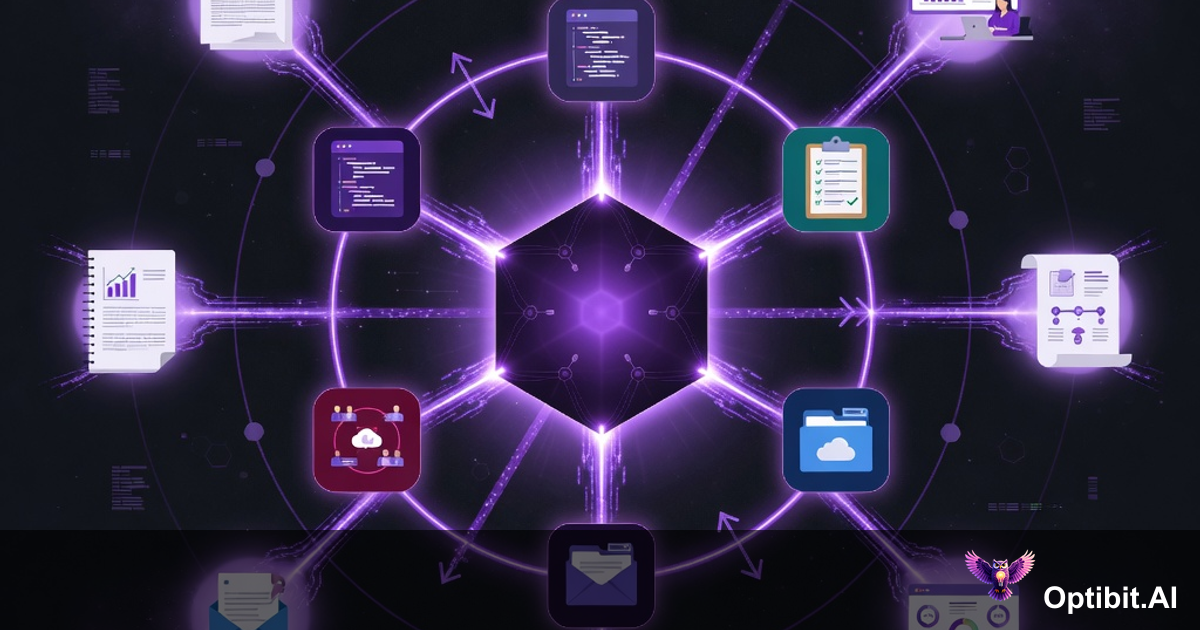
OptibitAI Is the AI Integration Layer for Your Entire Enterprise Stack
Every enterprise runs on dozens of tools. Code lives in GitHub or Bitbucket. Projects live in Jira or Asana. Documentation lives in Confluence. Customer records live in Salesforce. Files live in Google Drive, SharePoint, or S3. And now, sitting on top of all of it, is an AI mandate: use AI to move faster, produce more, and close the gap between what engineering ships and what the rest of the business can actually use.
The problem is that most AI deployments ignore the ecosystem entirely. Teams subscribe to a general-purpose LLM, write prompts manually, and generate content that knows nothing about what is in any of those tools. The AI is capable. The context is missing. And the output looks exactly like what you would expect from a system that has never seen your codebase, your customer data, your docs, or your deals.
OptibitAI is built around a different model. It is not another AI writing tool that sits in isolation. It is the agentic integration layer that connects your entire ecosystem to the LLM of your choosing, pulls the right context from the right sources at the moment of generation, and produces content that could only have come from your company. Securely. For every team. For any content type you can imagine.
Contents
- The Siloed AI Problem
- What an Agentic Integration Layer Actually Means
- Your Ecosystem, Connected
- You Choose Your LLM
- Generate Anything: Content for Every Team
- The Corpus and Selective Context Injection
- Custom Integrations, Custom Content Types
- 12 Writer Personas, 22 Audience Personas
- Secure by Design: Cloud and On-Premises
- What This Looks Like in Practice
The Siloed AI Problem
When enterprise teams adopt AI without a unifying layer, they create a new class of silos on top of the old ones. Engineering uses AI to write code. Marketing uses AI to write blog posts. Sales uses AI to draft proposals. Support uses AI to write help articles. Each team is using the same category of tool with no shared context, no shared outputs, and no mechanism for the AI to understand what is actually happening across the organization.
The results are predictable. Marketing writes about a product it learned about from the public website. Sales pitches features that shipped two quarters ago. Support drafts answers based on documentation that predates the latest release. Engineering ships features that none of the other teams' AI tools know about until someone updates a wiki page manually. The AI is fast. It is just fast at producing content that does not reflect your company's current reality.
The fix is not a better prompt. It is a connected layer that gives AI access to what is actually happening across your systems, routes the right context to each generation task, and produces output that is grounded in your actual product, your actual customers, and your actual data.
What an Agentic Integration Layer Actually Means
The word "agentic" is overloaded. In the context of OptibitAI, it means something specific: the system is not waiting for you to paste context into a prompt. It is connected to your tools, monitoring your sources, and ready to pull the relevant context from wherever it lives the moment you initiate a generation task. You tell it what to produce and for whom. It handles the retrieval, the context assembly, and the generation.
This is architecturally different from a general-purpose AI assistant. A general-purpose assistant is a blank canvas. You provide all the context. You manage all the retrieval. You decide what is relevant and paste it in. OptibitAI has integrations into your actual systems. When you generate a release blog post, it knows to pull from your GitHub diff, your Jira tickets, your existing corpus, and the appropriate writer and audience personas for that artifact. That retrieval and assembly is automatic, auditable, and repeatable.
GitHub · Jira · Salesforce · Confluence · Drive
Agentic Integration Layer
Claude · GPT · Grok · Gemini · Ollama
For Any Team
The agentic aspect also means the system does not forget. Every generation task contributes to an organizational corpus that makes the next generation task smarter. Approved outputs can be added back into the corpus, so each release cycle starts with better context than the last. The system learns your product, your voice, and your audience continuously, without requiring anyone to maintain a separate knowledge base manually.
Your Ecosystem, Connected
OptibitAI ships with native integrations across every category of enterprise tooling. You do not need to build connectors or write custom ETL pipelines to get your data into the generation workflow. The integrations are ready to configure and immediately available as context sources.
Development
- GitHub
- Bitbucket
Project Management
- Jira
- Asana
Documentation
- Confluence
- SharePoint
CRM
- Salesforce
File Storage
- Google Drive
- OneDrive
- AWS S3
Corpus Sources
- PDF, DOCX, XLSX
- MD, PPT, CSV
- Slack exports, code
What this means in practice: when an engineering team tags a release in GitHub, OptibitAI can pull the commits and diffs. When a PM closes a Jira sprint, OptibitAI can pull the issue context and resolution notes. When a sales rep needs a customer introduction, OptibitAI can pull the relevant Salesforce account context. The generation task draws from the actual source of truth, not from someone's memory of what shipped or what the customer said.
Need an integration that is not on this list? Custom integrations are available and built quickly. OptibitAI's integration architecture is designed to accommodate proprietary internal systems, vertical-specific tools, and enterprise data sources that do not have public APIs through the standard integration catalog. If your stack includes tools that are not listed above, that is not a blocker.
You Choose Your LLM
OptibitAI is LLM-agnostic by design. You are not locked into a single provider's model. You bring your existing LLM relationships, negotiate your own contracts, and connect the model that is right for your organization's cost structure, performance requirements, and compliance posture. OptibitAI orchestrates the context and the generation. The model is your choice.
For organizations with strict data residency or compliance requirements, OptibitAI deploys fully on-premises. Your data does not leave your infrastructure. The LLM runs locally via Ollama or connects to a self-hosted model instance. The integrations, corpus, and generation workflows operate entirely within your network perimeter. This is not a "private cloud" feature with an asterisk. It is a genuine air-gapped deployment option that enterprise security teams have approved.
Generate Anything: Content for Every Team
The content types that ship out of the box cover every function in the organization. This is not a list of hypothetical use cases. These are the artifact types that teams are using today across the product, engineering, sales, marketing, support, and leadership functions.
Product & Engineering
- Release notes (from GitHub diffs)
- Changelogs and API changelogs
- Technical documentation
- Migration guides
- Integration guides
- Roadmap summaries
- Feature comparison docs
- User guides
Marketing
- Product announcement blogs
- Press releases
- Feature launch copy
- Newsletter content
- Social posts (LinkedIn, Twitter/X)
- Video scripts
- Podcast talking points
- Website copy updates
Sales
- Deck updates per release
- ROI and value notes
- Competitive analyses
- Battle cards
- Demo scripts
- Customer introductions
- Proposal sections
- Executive briefing docs
Customer Success & Support
- QBR content and summaries
- Help center articles
- Onboarding guides
- Feature adoption emails
- Expansion opportunity briefs
- Renewal value summaries
- Support ticket templates
- Product update summaries for CS
Every artifact type is configurable. The system prompt for each type can be adjusted, the output format can be specified, and the audience targeting can be set at the organization level. A release notes template that works for your developer-facing changelog is different from the one that works for your executive stakeholder update. Both are available. Both draw from the same underlying source data through a different lens.
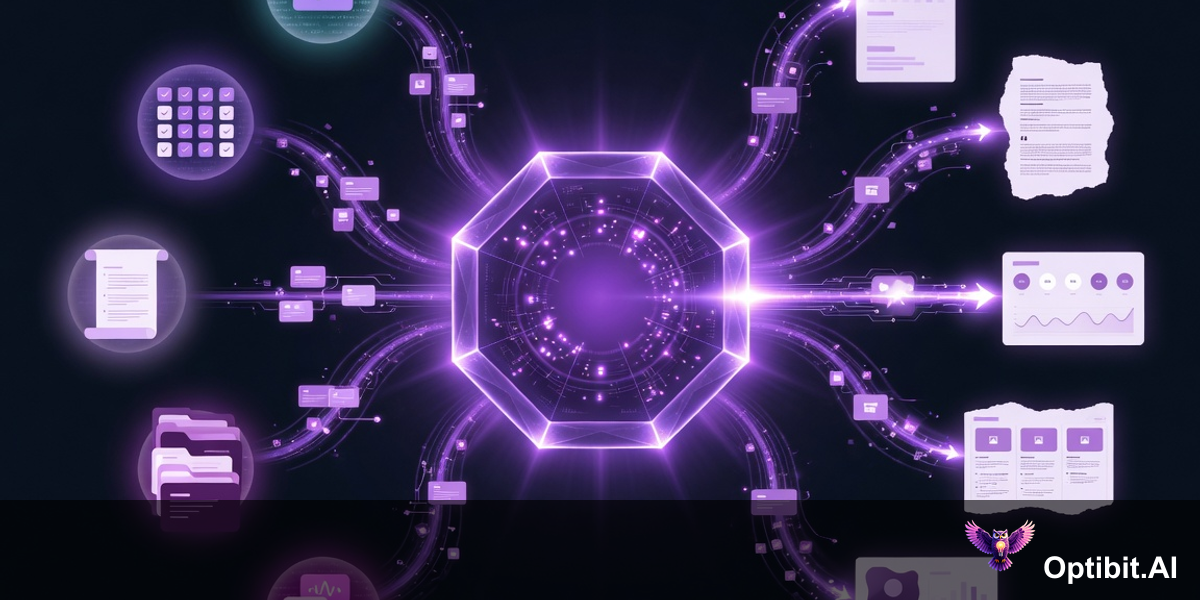
The Corpus and Selective Context Injection
Every OptibitAI workspace maintains a corpus: a structured collection of documents, assets, and reference material that grounds AI generation in your specific organizational knowledge. The corpus accepts any file format your teams work in: PDFs, Word and Google Docs, Excel spreadsheets, Markdown files, PowerPoint decks, code snippets, Slack exports, Figma links, and more.
What distinguishes OptibitAI's corpus from standard retrieval-augmented generation (RAG) is Selective Context Injection (SCI). In a standard RAG system, the AI decides which parts of the corpus are relevant to a given query and injects them automatically. This is where RAG systems fail in practice: the AI guesses wrong, injects irrelevant or contradictory context, and confidently produces hallucinated output that cites your own documents as authority for claims those documents do not actually support.
In version 2.2.0, generated assets themselves can be added back into the corpus. Approved release notes become context for the next quarter's executive summary. Approved battle cards become context for the next generation of competitive positioning. The corpus compounds over time: each approved, high-quality output makes the next generation task more grounded and more accurate. This is the compounding institutional knowledge effect that makes OptibitAI more valuable at month twelve than it was at month one.
Custom Integrations, Custom Content Types
Out-of-the-box integrations and artifact types cover the majority of enterprise use cases. For the cases they do not cover, OptibitAI is built to extend. Custom artifact types are created directly in the interface: define the content type, write the system prompt, set the default parameters, and it behaves identically to any built-in type. Your team can build a custom artifact type for internal use in minutes, without an engineering request.
Custom integrations for proprietary internal systems, vertical-specific platforms, and enterprise data sources that are not in the standard catalog are available through OptibitAI's integration architecture. If your organization runs a custom internal tool that holds critical product, customer, or operational context, that data can be connected. The integration engineering timeline is short. For organizations with bespoke data sources, OptibitAI's team builds the connector and makes the data available to the generation workflow.
Custom categories for asset organization are also available. Beyond the defaults (marketing, product, sales, support, technical, social), organizations can add categories that match their specific workflow: compliance, partner-facing, analyst relations, public sector, or whatever taxonomy their team actually uses. The system adapts to your organizational structure rather than requiring you to adapt to a fixed taxonomy.
12 Writer Personas, 22 Audience Personas
Context alone does not produce great content. The same information needs to be communicated differently depending on who is writing and who is reading. A release note written in the voice of a technical engineer reads differently from one written by an executive communicator. A product announcement written for a CTO reads differently from one written for a skeptical practitioner who needs to be convinced before they will advocate internally.
OptibitAI ships 12 writer personas that control the voice, tone, and structural approach of generated content:
- The Thought Leader — authoritative, perspective-forward, industry-shaping
- The Technical Translator — converts engineering detail into accessible clarity
- The Brand Storyteller — narrative-first, emotionally resonant, consistent with brand voice
- The Data-Driven Analyst — evidence-based, measured, precision-oriented
- The Sharp Provocateur — challenges assumptions, creates productive tension
- The Executive Communicator — concise, outcome-focused, leadership-ready
- The Sales Enabler — benefit-led, objection-aware, conversion-oriented
- The Casual Expert — approachable, peer-to-peer, jargon-free
- And four more, all customizable and shareable across your organization
The 22 audience personas define who is receiving the content: from The Demanding Executor to The Skeptical Critic to The Thorough Guardian, each persona adjusts what the AI emphasizes, what it anticipates as objections, and how it structures information to land with that specific reader type. Together, writer and audience personas let you generate the same information in the exact form it needs to take for each specific use case, without rewriting from scratch.
Secure by Design: Cloud and On-Premises
Enterprise AI adoption lives or dies on security and compliance. The BYOLLM model means your AI provider relationship, your data governance agreements, and your model access controls remain under your management. OptibitAI does not intermediate your LLM calls in a way that exposes your data to a third-party model you did not vet and approve.
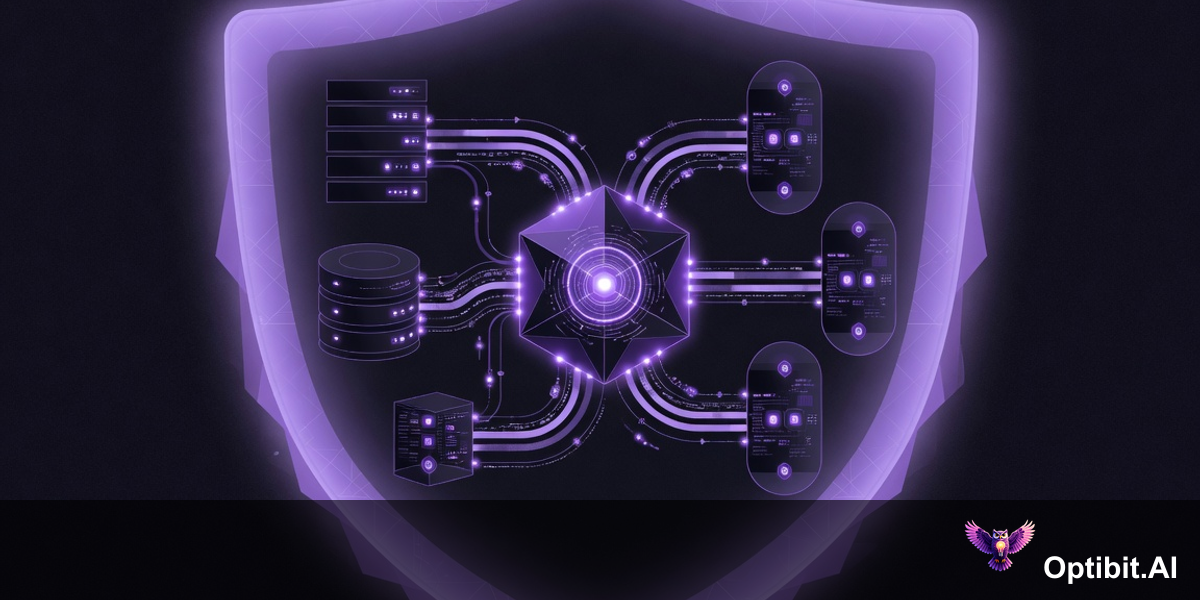
For organizations where data sovereignty is non-negotiable, OptibitAI deploys on-premises. The full platform runs in your infrastructure: Docker Compose for standard deployments, with validated configurations for specific enterprise environments. Your source system data, your corpus, your generated assets, and your LLM calls stay inside your network. GDPR and CCPA compliance is supported at the data layer. Role-based access control, approval workflows, and version history provide the audit trail enterprise governance requires.
The admin dashboard gives security and IT teams full visibility: organization management, member roles (admin, editor, viewer), integration management per workspace, auto-approval for trusted domains, and magic link authentication for frictionless enterprise onboarding without password sprawl.
What This Looks Like in Practice
Here is what the agentic layer looks like when a product team tags a release.
The release tag fires in GitHub. OptibitAI detects it, pulls the commits and diffs across the relevant repositories, maps them to the associated Jira tickets for context, applies the Confluence documentation from the sprint as supplemental background, and loads the organization's corpus of approved prior releases and customer language. The product manager opens OptibitAI, selects the release, chooses the artifact types they need: technical changelog, customer-facing release summary, sales team brief, and CS update. They select the appropriate writer and audience personas for each. They click Submit.
Three minutes later, all four artifacts are ready. The technical changelog reads like an engineer wrote it because the Technical Translator persona and the GitHub diff data produced output that reflects actual code changes. The sales brief reads like a seller wrote it because the Sales Enabler persona and the Salesforce account context produced output that connects features to pipeline-relevant value. The CS update reads like someone who knows the customer base wrote it because the Empathetic Educator persona and the corpus of prior customer communication produced output in the voice the CS team uses.
Each artifact shows exactly what context was used in its generation. Every version is stored with a timestamp and a diff. Any team member with appropriate permissions can initiate a revision in plain English, and the AI applies the change in context without regenerating the entire artifact. When the product manager approves an artifact, they can add it to the corpus, making it available as grounding material for next quarter's generation cycle.
This is what it means to have AI that knows your product. Not because you pasted your documentation into a prompt, but because your entire ecosystem is connected and the right context flows to every generation task automatically.
See what OptibitAI can do for your organization at optibit.ai.