
By 2030, Most Enterprises Will Ship Daily. Is the Rest of Your Company Ready?
Gartner projects that by 2030, more than half of all enterprise software organizations will be shipping to production daily. Not weekly. Not in two-week sprints. Daily.
For engineering teams, this is a trajectory they can see coming and are actively building toward. CI/CD pipelines, feature flags, automated testing, and AI-assisted development are all accelerating the path to daily delivery. The technical infrastructure for shipping every day is being laid right now across thousands of organizations.
For the rest of the company, this projection should be alarming. Because the GTM content problem that already exists at weekly shipping velocity does not just get worse at daily shipping velocity. It becomes mathematically impossible to solve with people.
Here is what daily shipping at enterprise scale actually means downstream: 250 releases per year. 250 sets of release notes, customer announcements, updated sales materials, refreshed support documentation, revised AI knowledge bases, and recalibrated competitive intelligence. Every working day, something ships. Every working day, every customer-facing team needs to know what changed and say something coherent about it.
No content team on earth can keep up with that manually. The question is not whether the gap will open. It is whether your organization will have a pipeline in place before it does.
Contents
Where We Are Now
Most enterprise software teams today ship on a weekly or biweekly cadence. The best-performing teams ship multiple times per week. A small but growing cohort is already shipping daily in production environments.
Even at weekly velocity, the content lag is severe. The median time from feature ship to first customer-facing content is 23 days. Roughly half of all shipped features receive no customer-facing communication at all. Sales materials lag product reality by one to three quarters. AI support bots confidently answer questions based on documentation that describes a product from months ago.
This is the baseline. This is the world where teams ship weekly and still cannot keep up. Now compress the release cadence by a factor of five.
The Math at Daily Velocity
The content production requirement at daily shipping velocity is not linear. It compounds because every uncommunicated release adds to a backlog that the next release lands on top of.
Here is what the numbers look like for a mid-size enterprise shipping team:
Content Requirement at Daily Shipping Velocity
And that assumes a lean artifact set of five items per release. A team with a full GTM motion, managing sales enablement content, competitive intelligence, partner communications, and customer success materials alongside standard release documentation, is looking at eight to ten artifacts per release. The gap widens further.
Hiring is not the answer. The headcount required to manually cover a 250-release-per-year content requirement would cost more than most content operations budgets for an entire decade. And the problem with hiring writers to cover daily releases is not just cost. It is latency. Even a fully staffed content team operates on a production timeline that cannot compress below 24 to 48 hours per artifact. At daily shipping velocity, that means content is always at least one release behind. Permanently.
What Daily Shipping Means for Each Team
The impact of daily shipping velocity is not uniform across the organization. Each downstream function faces a distinct version of the same problem.
Marketing
250 releases per year means 250 opportunities to announce, position, and drive awareness for new capabilities. At current capacity, most marketing teams can execute on 20 to 40 release-related communications per year. The other 210 releases are invisible to the market. Feature adoption suffers. Competitive positioning erodes because launched capabilities go unannounced while competitors make noise about theirs.
Sales
Battle cards, objection guides, and competitive teardowns cannot be updated 250 times per year by a sales enablement team of two or three people. At daily velocity, the sales team is permanently operating with a mental model of the product that lags the actual product by weeks. They lose competitive deals on capability gaps that engineering already closed. They field objections with responses that reference limitations that no longer exist.
Customer Success
CS teams drive expansion by connecting customers to value they have not yet discovered. At daily shipping velocity, the volume of new value being created outpaces any CS team's ability to manually surface it to the right accounts. Customers churn not because the product stopped improving, but because no one told them it had. The expansion motion breaks down not from lack of effort but from lack of information throughput.
Support
Support documentation and AI knowledge bases require updates with every release that changes product behavior. At 250 releases per year, a support team maintaining documentation manually will always be behind. Customers file tickets for issues that have already been resolved. AI bots answer questions about workflows that no longer exist. Support load increases precisely because the content pipeline cannot keep pace.
Partners and Channel
Channel partners are already the last to know about product changes at weekly velocity. At daily velocity, partners are effectively operating in a permanent information blackout. They cannot resell and position a product they do not understand. Partner-sourced revenue atrophies not because partners lose interest but because the organization loses the ability to keep them current.

The Velocity Gap Is Already Structural
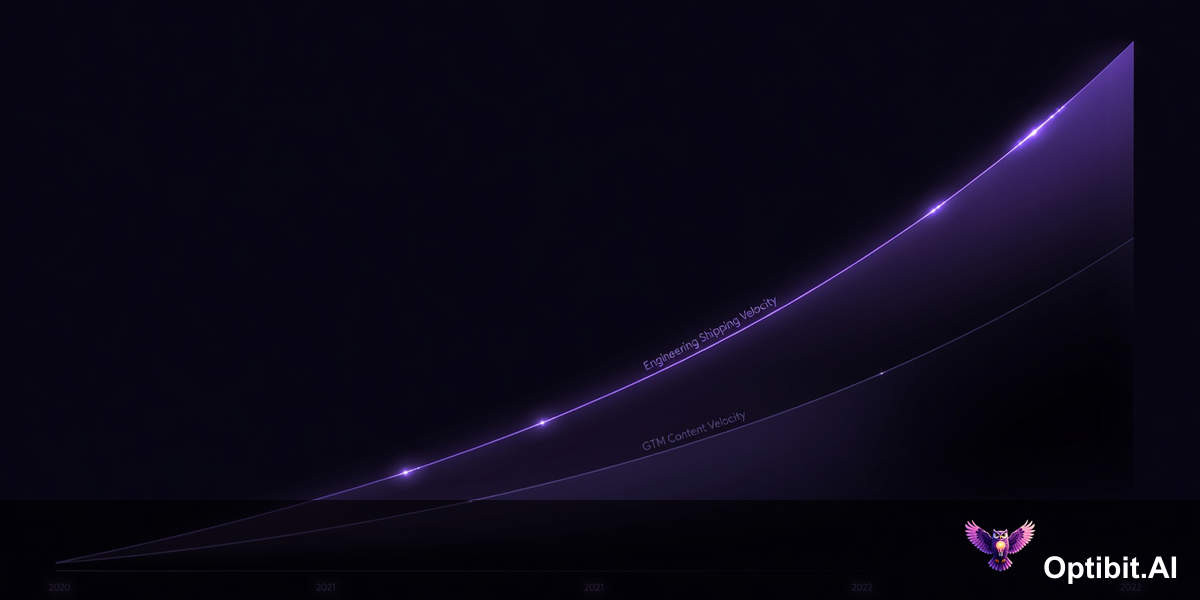
The gap between engineering velocity and GTM content velocity is not a personnel problem or a prioritization problem. It is a structural problem caused by a fundamental mismatch between how fast software can be produced and how fast human-generated content can follow it.
AI coding tools have accelerated software production dramatically. A senior engineer using AI-assisted development today ships features at roughly twice the rate they did three years ago. That acceleration will continue. The path to daily enterprise shipping is being paved by tools that make engineering faster, not by organizational restructuring.
GTM content production has not seen the same acceleration. Writing, reviewing, and publishing a release announcement or a battle card update still takes roughly the same amount of human time it did in 2020. The tools available to content teams have improved, but the fundamental process is unchanged: a human has to understand what changed, translate it into audience-appropriate language, get it reviewed, and publish it. That chain has a minimum latency that no amount of hiring or prioritization can reduce below a threshold that is incompatible with daily shipping.
This is why the GTM Bottleneck Paradox is not a temporary phenomenon. The engineering-side acceleration is structural and continuing. The GTM-side content production constraint is also structural. The gap between them can only be closed by changing the content production process itself, not by adding more people to an unchanged process.
What Breaks First
Organizations that arrive at daily shipping velocity without an automated content pipeline will experience a predictable sequence of failures.
First, release notes become perfunctory. The team can no longer produce meaningful release notes for every release, so they either skip them or publish minimal one-liners that communicate nothing useful. Customers lose the ability to track what the product is doing. Trust in the changelog erodes.
Second, sales and marketing decouple from engineering reality. The product roadmap and the marketing narrative stop referring to the same product. Sales decks describe a product that launched six months ago. Marketing campaigns promote capabilities that have been superseded. Customers arrive expecting a product that has already evolved past the version they were sold.
Third, support volume increases. Without current documentation, customers cannot self-serve accurately. AI bots draw from stale knowledge bases and give wrong answers at scale, as we explored in Why Your AI Chatbot Is Telling Customers the Wrong Thing. Ticket volume grows even as the product improves, because the communication infrastructure has collapsed.
Fourth, competitive position weakens. Competitors who have built automated content pipelines communicate every release. Organizations that have not go silent. In markets where perception of velocity matters as much as actual velocity, silence reads as stagnation.
The Only Answer That Scales
The only content production approach that keeps pace with daily shipping velocity is one that generates content at the point of shipping, from the source of truth, automatically.
That means connecting the repository directly to the content pipeline. When a release merges, the system reads the pull requests, commit messages, and associated context, generates customer-facing content artifacts for each downstream audience, and routes them for human review and approval. The human role shifts from writing to editing: approving, refining, and publishing content that the system has drafted from ground truth, rather than starting from zero for each of 250 annual releases.
This is the only model that closes the velocity gap without requiring headcount to scale linearly with shipping frequency. A team that took four hours to produce a release content package manually can review and approve an AI-generated draft in 30 minutes. Applied across 250 annual releases, that difference is the line between a content pipeline that keeps up and one that is perpetually underwater.
This is what OptibitAI is built to do: connect your repository to a content generation pipeline that produces coordinated release artifacts for every team, every release, automatically. The system does not get slower as shipping velocity increases. It scales with the engineering team, not against it.
Why to Build the Pipeline Now
2030 is four years away. Most enterprises have not reached daily shipping velocity yet. It would be reasonable to treat this as a future problem.
It is not a future problem. It is a present problem at a smaller scale, and the organizations that will handle daily shipping gracefully are the ones that build the content pipeline infrastructure now, while the stakes of getting it wrong are lower.
The content pipeline is not something you can retrofit overnight. It requires connecting systems that are currently disconnected: the repository, the content management workflow, the sales enablement platform, the support knowledge base, the AI bot's retrieval index. Building those connections, establishing the human review process, and calibrating the content quality for each audience takes time. The organizations starting now will have four years of iteration and refinement before daily shipping becomes the norm. The organizations that wait will be building a pipeline under live-fire conditions while the velocity gap is already at its worst.
The question every GTM leader, VP of Product, and Head of Revenue Operations should be asking right now is not "will we ever ship daily?" It is "when we do, what is our content pipeline?"
If the answer is "the same process we have today, just faster," the math above tells you what happens. The gap opens, the silences accumulate, and the market falls further and further behind what the engineering team actually built.
The companies that win in the daily-shipping era will not be the ones with the best engineering pipelines. Every enterprise will have those. They will be the ones where the rest of the company can keep up.
Try OptibitAI to build the content pipeline that scales with your shipping velocity, starting today.